April 24, 2026
Yandex Translate vs Google Translate: Which is better in 2026?
The straightforward answer is that Google Translate is the stronger general-purpose option in 2026, by a significant margin on most language pairs. The more useful answer is that Yandex Translate still has a genuine case for Russian, Ukrainian, and other languages of the Commonwealth of Independent States, where its training data depth remains an advantage.
This article covers what each tool actually does well, where each falls short, and how the gap between them has changed since Google's 2024 language expansion and 2025 quality upgrade.
In this article
- What is Yandex Translate?
- What is Google Translate, and what has changed recently?
- How do they compare on accuracy?
- How does language coverage differ?
- How does pricing compare?
- API and developer use
- Which tool is better for which use case?
- A note on data security
- FAQs
What is Yandex Translate?
Yandex Translate is a machine translation service developed by Yandex, a Russian technology company. It uses a hybrid of neural machine translation (NMT) and statistical machine translation (SMT), with the system routing documents through both engines and selecting the better output. This architecture, while older than the approach used by current LLM-based systems, performs well on language pairs where Yandex's training data is particularly deep: Russian, Belarusian, Ukrainian, Uzbek, Kazakh, and other languages spoken across Russia and the former Soviet states.
Yandex Translate supports approximately 100 language pairs, with the strongest performance on CIS-region languages. For users working primarily in Eastern Europe or Central Asia, it offers a level of regional linguistic depth that general-purpose models have historically struggled to match.
What is Google Translate, and what has changed recently?
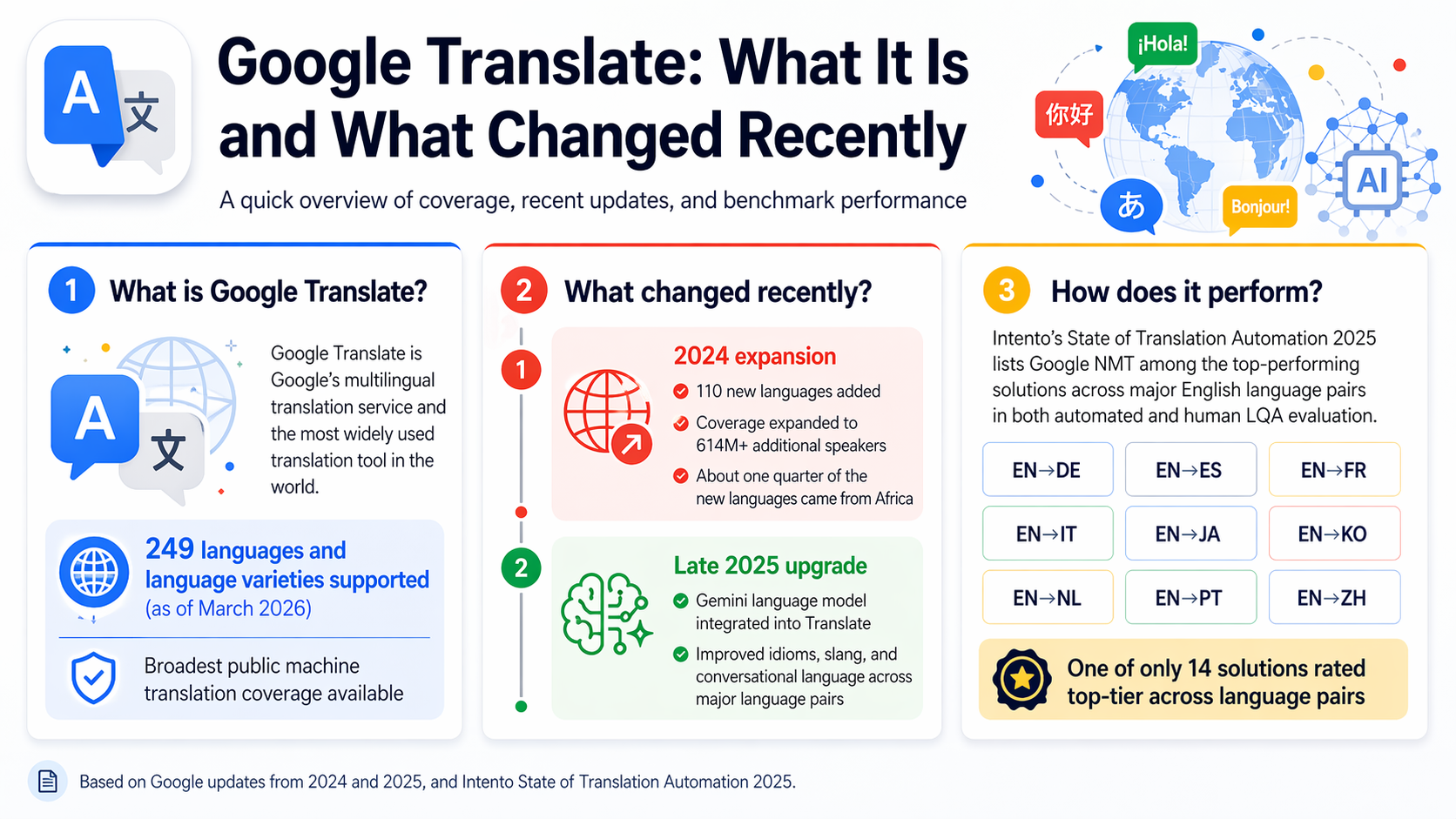
Google Translate is a multilingual translation service developed by Google, and by most measures the most widely used translation tool in the world. As of March 2026, it supports 249 languages and language varieties, making it the broadest-coverage machine translation service publicly available.
Two developments are worth noting for anyone comparing Google to other tools based on older information. In 2024, Google expanded Translate by 110 new languages, adding coverage for more than 614 million additional speakers, with about a quarter of new languages coming from Africa. In late 2025, Google upgraded Translate with its Gemini language model, improving performance on idioms, slang, and conversational language across major language pairs.
According to Intento's State of Translation Automation 2025, Google NMT appears among the top-performing solutions across English to German, English to Spanish, English to French, English to Italian, English to Japanese, English to Korean, English to Dutch, English to Portuguese, and English to Chinese pairs in both automated and human LQA evaluation. It is one of only 14 solutions that achieved top-tier performance across language pairs in that study.
How do they compare on accuracy?
For most language pairs, Google is the stronger option in 2026. Its Gemini-upgraded models score well on human LQA evaluation across European and Asian pairs, and Intento's 2025 study confirmed Google NMT as a top performer across nine of the eleven language pairs assessed. Yandex does not appear among the top-14 solutions across any of those language pairs in the same evaluation.
That said, the comparison is more nuanced for Russian and CIS-region languages. Yandex's training data for Russian is substantially richer than Google's, and its hybrid NMT/SMT architecture handles the grammatical complexity of Russian (its extensive case system, aspect distinctions, and long-range agreement) with consistency that general-purpose models can still miss. For professional use cases involving Russian-language legal documents, regional government communications, or content targeting Russian-speaking markets specifically, Yandex is worth testing alongside Google before making a tool decision.
Intento's data also notes that Yandex achieves relatively stronger scores in certain European languages like French in baseline evaluation, though it suffers quality degradation when glossaries are introduced, unlike LLM-based systems which generally improve with customisation.
The broader context worth holding here: both tools are single-model NMT systems. As tracked in MachineTranslation.com's internal analysis, the translation errors that remain in 2026 are almost entirely semantic rather than syntactic — wrong tone, wrong register, wrong cultural framing. Both Google and Yandex will produce those errors occasionally, and neither has a mechanism to flag when it has.
How does language coverage differ?
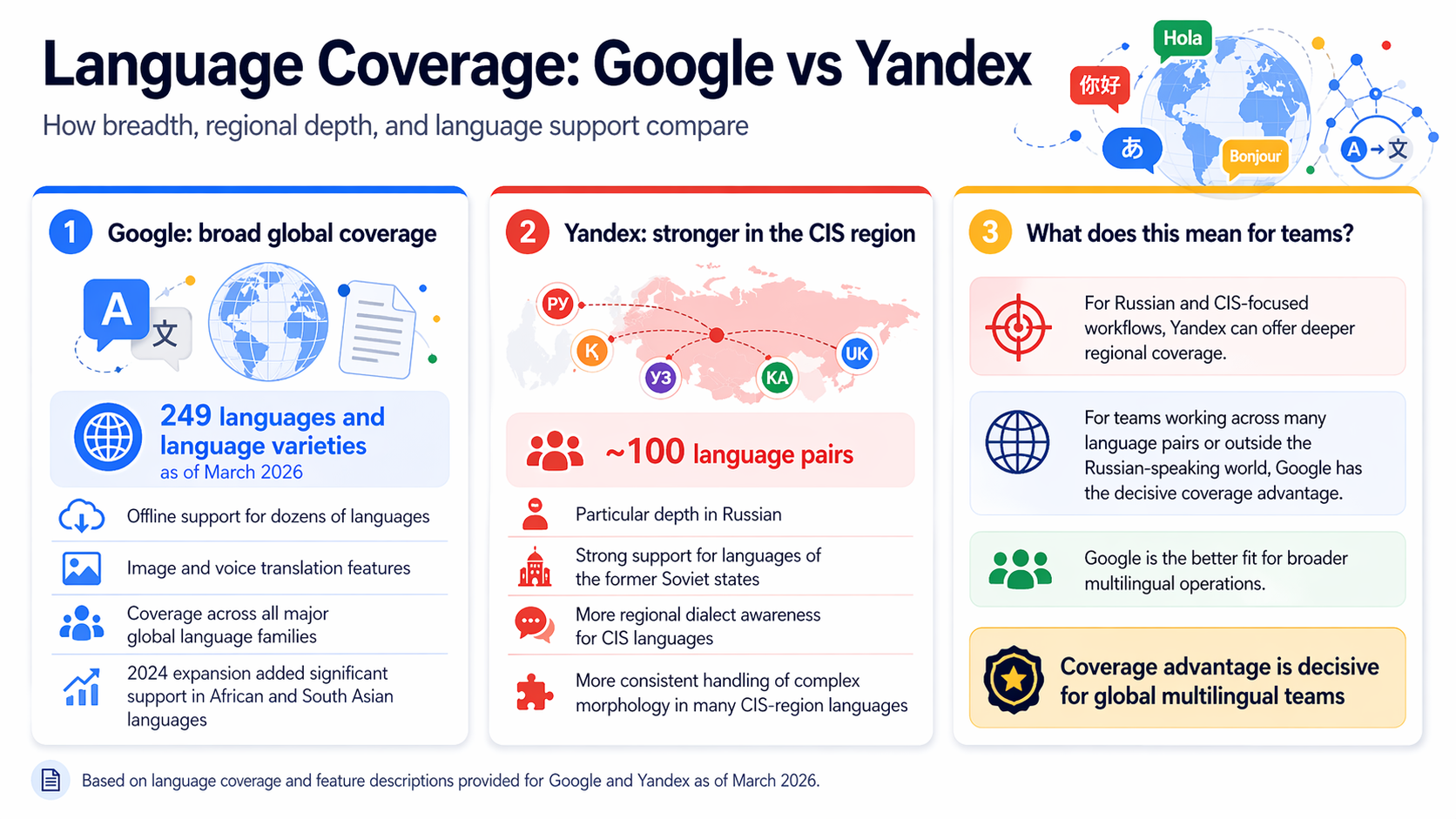
Google supports 249 languages and language varieties as of March 2026, including offline support for dozens of languages, image and voice translation, and coverage across all major global language families. Its 2024 expansion added significant coverage in African and South Asian languages where other tools still have limited support.
Yandex supports approximately 100 language pairs, with particular depth in Russian and the languages of the former Soviet states. For those languages, Yandex's coverage is not just broader in a quantitative sense but qualitatively deeper: more training data, more regional dialect awareness, and more consistent handling of the morphological complexity that characterises many CIS-region languages.
For teams working across multiple language pairs or needing to translate into languages outside the Russian-speaking world, Google's coverage advantage is decisive.
How does pricing compare?
Google Translate (consumer): Free with no limits for standard use.
Google Cloud Translation API: $20 per million characters for the Basic model (NMT). Advanced model pricing is higher and includes AutoML features for custom training.
Yandex Translate (consumer): Free with usage limits.
Yandex Translate API: A free tier is available for low-volume use. Paid tiers scale by volume; specific per-character pricing should be confirmed via the current Yandex Cloud documentation as it varies by region and plan.
For both tools, the free consumer interfaces are accessible with no account required for basic use. API access requires account registration and, in Yandex's case, a Yandex Cloud account.
MachineTranslation.com provides access to both Google and Yandex alongside 20 other models, with a free daily-reset tier that requires no sign-up. The Pro Plan is $19/month for unlimited translations.
API and developer use
Google Cloud Translation API is one of the most mature and extensively documented translation APIs available. It supports REST and client libraries in multiple languages, integrates with Google's broader cloud ecosystem (BigQuery, Vertex AI, Cloud Storage), and handles batch translation well at scale. For developers already working in Google Cloud, it is the natural choice.
Yandex Translate API supports REST integration and is documented for standard use cases including text translation, language detection, and website translation. It is a practical option for developers working on applications targeting Russian-speaking markets, particularly where regional linguistic accuracy is more important than broad language coverage.
One consideration for Yandex API use: see the data security note in the section below.
Which tool is better for which use case?
Google Translate is the stronger choice for most use cases in 2026. Its broader language coverage, consistent top-tier benchmark performance across major language pairs, and Gemini-powered quality improvement make it a reliable default for general professional translation.
Yandex has a genuine case in a specific set of scenarios: Russian-language content, Ukrainian and Belarusian content, legal or governmental communications targeting CIS-region audiences, and any context where the depth of training data in a specific regional language matters more than breadth. For those use cases, testing Yandex output against Google's on your actual content is worthwhile before committing to either.
A note on data security
For users handling confidential content, the data residency question matters.
Google processes translation data under standard Google Cloud terms, with data handling commitments that align with US and EU data protection frameworks. Enterprise users can configure data residency settings.
Yandex is a Russian company. Data processed via the Yandex Translate API is processed on Yandex infrastructure, which is subject to Russian data security laws. For users translating sensitive business content, legal documents, or regulated-industry material, this is worth weighing against Yandex's regional language advantages.
Self-hosted or on-premise alternatives eliminate this concern for either tool, though they require additional infrastructure.
FAQs
1. Is Yandex Translate better than Google Translate for Russian?
For Russian specifically, Yandex's training data depth gives it an advantage on regional dialect awareness, morphological complexity, and culturally specific phrasing. For general content, the difference has narrowed since Google's 2025 Gemini upgrade. For professional Russian-language translation, it is worth running both and comparing on your specific content type before choosing.
2. How many languages does Google Translate support in 2026?
As of March 2026, Google Translate supports 249 languages and language varieties. It received its largest expansion in 2024, adding 110 new languages, with particular growth in African and South Asian language families.
3. Is Yandex Translate free?
Yes, the Yandex Translate consumer interface is free to use. API access requires a Yandex Cloud account and is subject to usage-based pricing above the free tier.
4. Which is more accurate: Yandex or Google Translate?
For most language pairs, Google ranks higher in independent benchmark evaluation. According to Intento's State of Translation Automation 2025, Google NMT appears among the top performers across nine language pairs assessed in human LQA evaluation. Yandex is not among the top-14 solutions across any of those pairs, but retains an edge for Russian and CIS-region languages where its training data is deeper.
5. Is Yandex Translate safe to use for confidential documents?
Data processed via the Yandex Translate API is handled by Yandex infrastructure under Russian data security law. For sensitive business content or regulated-industry documents, that is a relevant consideration. Google Cloud Translation operates under US and EU data handling terms, which most enterprise security policies are better aligned with.
6. Can I use both Google Translate and Yandex in one workflow?
MachineTranslation.com runs both Google and Yandex as part of its 22-model system, alongside ChatGPT, Claude, DeepL, and others. Rather than managing separate integrations, you get the output from all of them in one place, with quality scores showing how much the models agree. That agreement signal is particularly useful when you're working across multiple language pairs with different model-strength profiles. Free to use, no sign-up required.
Both Google and Yandex are part of the 22-model system at MachineTranslation.com. Translate free, no sign-up required.