March 13, 2026
How to translate legal documents from English to Spanish without errors
A single mistranslated clause can void a contract. A wrong term in a liability waiver can expose a business to litigation. A hallucinated date in a non-disclosure agreement can make an entire document legally unenforceable. These are not theoretical risks. They are the documented outcomes of trusting a single AI model with legal content – and they happen silently, without warning, because no individual model knows when it is wrong.
Translating legal documents from English to Spanish demands a level of reliability that most translation tools are not designed to provide. This guide explains where the errors come from, what they look like in practice, and how to use the right workflow to eliminate them.
Table of Contents
Why legal Spanish translation is different from everything else
What AI translators get wrong on legal Spanish documents
How SMART reduces legal translation error risk
How to translate a legal document on MachineTranslation.com: step-by-step
When AI is not enough: Adding human verification
Legal document translation checklist
FAQs
Why legal Spanish translation is different from everything else
Most translation tasks are forgiving. A slightly awkward sentence in a marketing email costs nothing. A tone mismatch in a social post goes unnoticed. Legal documents are the opposite: every word carries defined legal weight, and imprecision is not a stylistic choice – it is a liability.
Two features of legal Spanish make this harder than it first appears.
The cost of a single wrong word
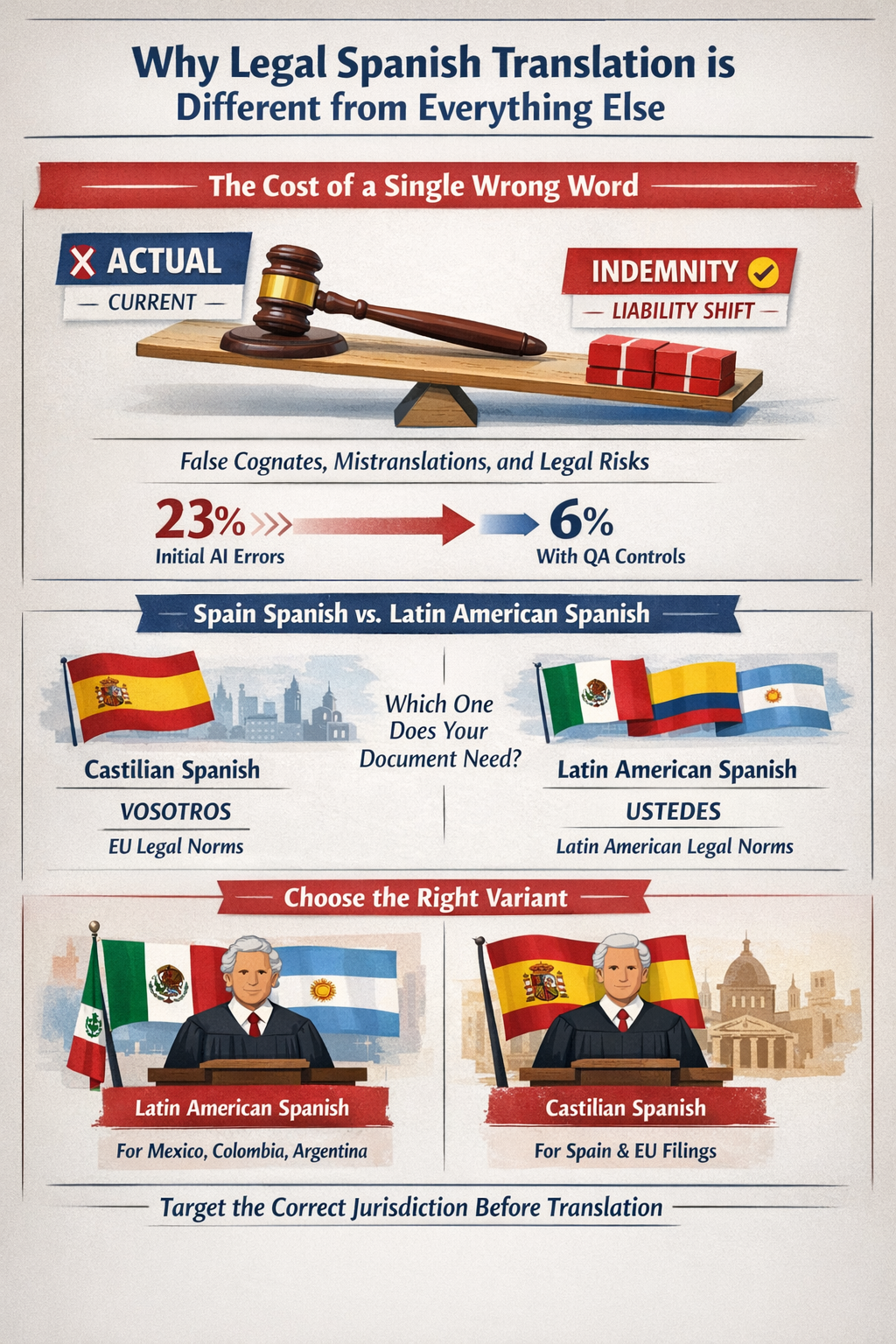
In English-to-Spanish legal translation, false cognates are a persistent source of costly errors. Words like actual (which means "current" in Spanish, not "actual"), eventual (which means "possible," not "inevitable"), and compromiso (which means "commitment" or "obligation," not necessarily "compromise") regularly trip up AI models that treat surface-level similarity as semantic equivalence.
The consequences scale with document type. In a contract, a mistranslated indemnification clause can shift liability from one party to another. In a court submission, a date hallucinated by an AI model becomes a factual misrepresentation. According to internal Tomedes data, 23% of initial AI-generated translations of legal content required corrections – but when quality assurance controls and glossary enforcement were applied, that rate dropped to 6%. The mechanism, not the model, is what drives the improvement.
Spain Spanish vs. Latin American Spanish: Which one does your document need?
Spanish is not a single language for legal purposes. Spain uses the vosotros form and follows EU legal conventions, while Latin American jurisdictions (Mexico, Colombia, Argentina, and others) use ustedes and apply different legal frameworks, terminology traditions, and formality norms.
A contract translated for a Mexican court using Castilian Spanish terminology is not just stylistically wrong, it may be jurisdictionally ambiguous. According to the Intento State of Translation Automation 2025, error rates in Latin American Spanish vary meaningfully across AI models, with DeepL next-gen performing best but other major tools showing significantly higher error counts dominated by grammar issues. The implication is clear: the model you choose, and whether it knows which Spanish variant to apply, determines your legal exposure.
The right workflow identifies the target jurisdiction before translation begins. If you need Spanish for use in Mexico, Colombia, or Argentina, specify "Latin American Spanish" in your tool settings. If the document is for Spain or EU-level filings, use Castilian Spanish. MachineTranslation.com's English to Spanish translation supports both variants, but selecting the correct one before running the document is the first error-prevention step you control.
What AI translators get wrong on legal Spanish documents
Understanding where single-model AI fails on legal content is not a reason to avoid AI translation. It is a reason to use it differently.
