April 16, 2026
Grok vs ChatGPT for translation: which one should you use in 2026?
You probably already have a tab open with one of them. The question is whether what comes out of it is accurate enough to use (for a client document, a product page, a contract clause) without spending the next 20 minutes second-guessing every sentence.
This article compares Grok 4.1 and ChatGPT (GPT-5.4) specifically for translation use: what each does well, where each fails, and what you need when neither is quite enough.
In this article
- What is Grok and how has it evolved?
- What is ChatGPT and what does GPT-5.4 change?
- How do Grok and ChatGPT compare on translation accuracy?
- How does language support differ between Grok and ChatGPT?
- How does pricing compare between Grok and ChatGPT?
- Which has the better API for translation workflows?
- Which tool is better for which type of translation?
- What do you do when accuracy has to be certain?
- FAQs
What is Grok and how has it evolved?
Grok is a large language model developed by xAI, the AI company founded by Elon Musk in 2023 (now part of SpaceX following an acquisition in February 2026). Since its launch, Grok has progressed through four major generations: Grok 1 (2023), Grok 2 (2024), Grok 3 (February 2025), and Grok 4 (July 2025), with Grok 4.1 available from late 2025.
Grok's defining architectural feature is real-time data access. Unlike most large language models trained on static datasets, Grok integrates live web search and X (formerly Twitter) platform data into its outputs. This makes it distinctly capable for content involving current events, emerging terminology, recently coined industry language, or time-sensitive source material — categories where models trained on older snapshots can introduce outdated phrasing or miss recent context.
For translation specifically, Grok's real-time access is a genuine advantage in a narrow but important set of use cases: translating news content, press releases, regulatory updates, and material that references current events or newly emerging terms. Its multilingual support has improved with each successive model generation. Grok 4.1 features a 131K-token context window, improved multilingual output, and native tool use with real-time search integration.
Where Grok still underperforms relative to dedicated translation infrastructure: it is a general-purpose model, not a translation-specific one. It produces a single output with no internal verification mechanism. The output quality varies by language pair and content type, and there is no cross-model check to catch the output when it is wrong.
What is ChatGPT and what does GPT-5.4 change?
ChatGPT is a conversational AI developed by OpenAI, built on its GPT (Generative Pre-trained Transformer) architecture. It launched in November 2022 and became the fastest-growing consumer application in history. The current model as of April 2026 is GPT-5.4, released March 5, 2026.
For translation tasks, ChatGPT is among the strongest general-purpose LLMs available. In MachineTranslation.com's internal benchmark across 5,000 words of mixed technical and marketing content, ChatGPT scored 89.8% accuracy — performing well on surface-level quality but producing hallucinated content in two key sentences during that test. On independent scientific benchmarks, GPT-5.4 scores 92.0% on the GPQA Diamond test (PhD-level science reasoning), indicating strong performance on complex, fact-dependent content where accuracy matters.
ChatGPT supports a wide range of languages and handles complex sentence structures, idiomatic phrasing, and professional register well across European and major Asian language pairs. Its weaknesses for translation are structural rather than quality-related: like every single-model AI system, it cannot verify its own output. When it hallucinates (producing a fluent-sounding translation that is factually or semantically wrong), there is no signal to alert the user.
How do Grok and ChatGPT compare on translation accuracy?
Both tools produce high-quality translations for general content. The meaningful differences emerge at the edges — when content is specialized, technical, time-sensitive, or high-stakes.
Where Grok has an advantage: Current-events content, emerging terminology, and material requiring up-to-date context. Grok's live search integration means it can draw on recent usage patterns when translating news articles, product launches, or regulatory updates — content where a model trained on data from six months ago may produce outdated phrasing.
Where ChatGPT has an advantage: Structured, fact-dense content — scientific, legal, and technical text where accuracy on established terminology matters more than recency. GPT-5.4's 92.0% GPQA benchmark score and a 33% lower false-claim rate compared to earlier models make it the stronger choice for high-precision professional translation of complex source material.
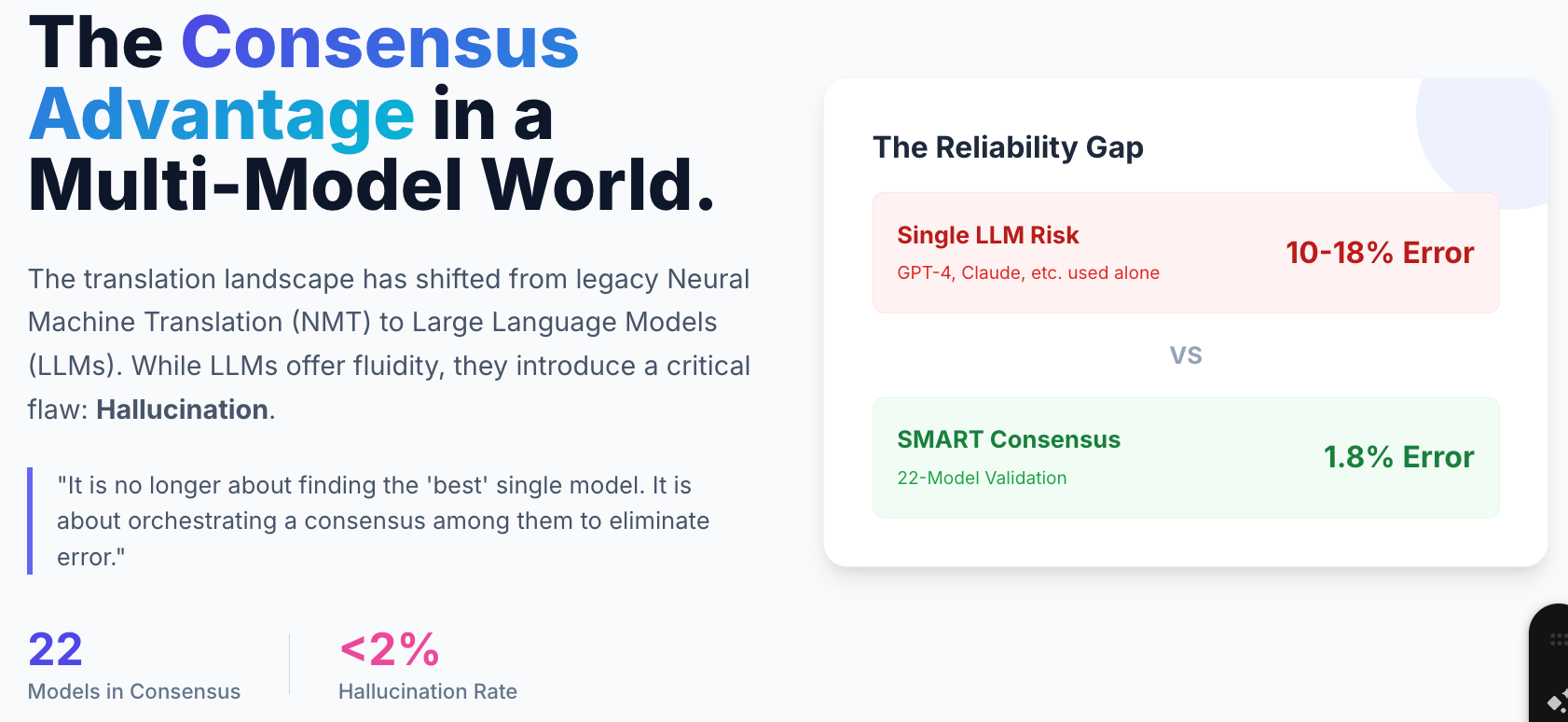
What neither tool can do: Verify its own output. Individual top-tier LLMs (including both Grok and ChatGPT) hallucinate or fabricate content between 10% and 18% of the time during translation tasks, according to data synthesized from Intento's State of Translation Automation 2025 and WMT24 General Machine Translation Findings. For professional, client-facing, or regulated content, that range is not an acceptable margin of error.
| Grok 4.1 | ChatGPT (GPT-5.4) | |
|---|---|---|
| Best for | Time-sensitive, current-events content | Structured, technical, fact-dense content |
| Real-time data access | Yes — live X and web integration | No — static training data |
| Accuracy benchmark | AIME 2025: 91.7% (math reasoning) | GPQA Diamond: 92.0% (science reasoning) |
| Translation benchmark | ---- | 89.8% on 5,000 words mixed content (with 2 hallucinated sentences) |
| Output verification | Single model, no verification signal | Single model, no verification signal |
| Hallucination rate (single model) | 10–18% (Intento/WMT24) | 10–18% (Intento/WMT24) |
How does language support differ between Grok and ChatGPT?
ChatGPT supports a broad set of languages across all major language families. It performs strongest on European language pairs and major Asian languages (Chinese, Japanese, Korean), with somewhat less consistent quality on lower-resource languages.
Grok has progressively expanded its multilingual support across model generations. Grok 4.1 improves meaningfully on earlier versions for non-English output, though it remains oriented toward high-resource language pairs where training data is abundant.
MachineTranslation.com supports 330+ languages by aggregating 22 AI models simultaneously (including both Grok and ChatGPT) and selecting the output the majority agrees on. For teams working across multiple markets or less common language pairs, this approach eliminates the need to evaluate each tool against each language independently.
For specific language pair guidance: English to Spanish, English to French, English to German.
How does pricing compare between Grok and ChatGPT?
Grok (xAI):
- Free tier: Available via X with limited Grok access
- X Premium+: $22/month — includes Grok chatbot access
- SuperGrok: $30/month — expanded capabilities
- API (Grok 4.1): $0.20 per 1 million input tokens / $0.50 per 1 million output tokens — among the lowest API rates in the LLM market
ChatGPT (OpenAI):
- Free tier: Available with limited capabilities
- ChatGPT Plus: $20/month
- ChatGPT Pro: $200/month
- API (GPT-5.4): $1.75 per 1 million input tokens / $14.00 per 1 million output tokens
MachineTranslation.com:
- Free: Daily limit with no sign-up required; translations reset every 24 hours
- Pro Plan: $39/month — unlimited translations, document processing, original layout preserved
- 24-hour full access: $9.50 (one-time, no auto-renewal)
Grok's API pricing is notably lower than ChatGPT's, which makes it cost-attractive for high-volume API usage. However, for translation specifically, per-token costs are only one dimension — output quality, verification, and error correction costs matter equally in professional contexts.
Which has the better API for translation workflows?
Grok's API became fully available with xAI's shift to usage-based pricing in October 2025. Pricing is among the lowest in the market at $0.20/1M input tokens (Grok 4.1). Documentation has expanded significantly since Grok 3 beta. For developers building pipelines that need real-time data integration, Grok's API is a strong option.
ChatGPT's API (OpenAI) is the most mature and widely documented LLM API available. It supports function calling, structured output, custom GPTs, and a wide integration ecosystem. At $1.75/1M input tokens for GPT-5.4, it is considerably more expensive than Grok but has the deeper customization and stability track record that enterprise workflows typically require.
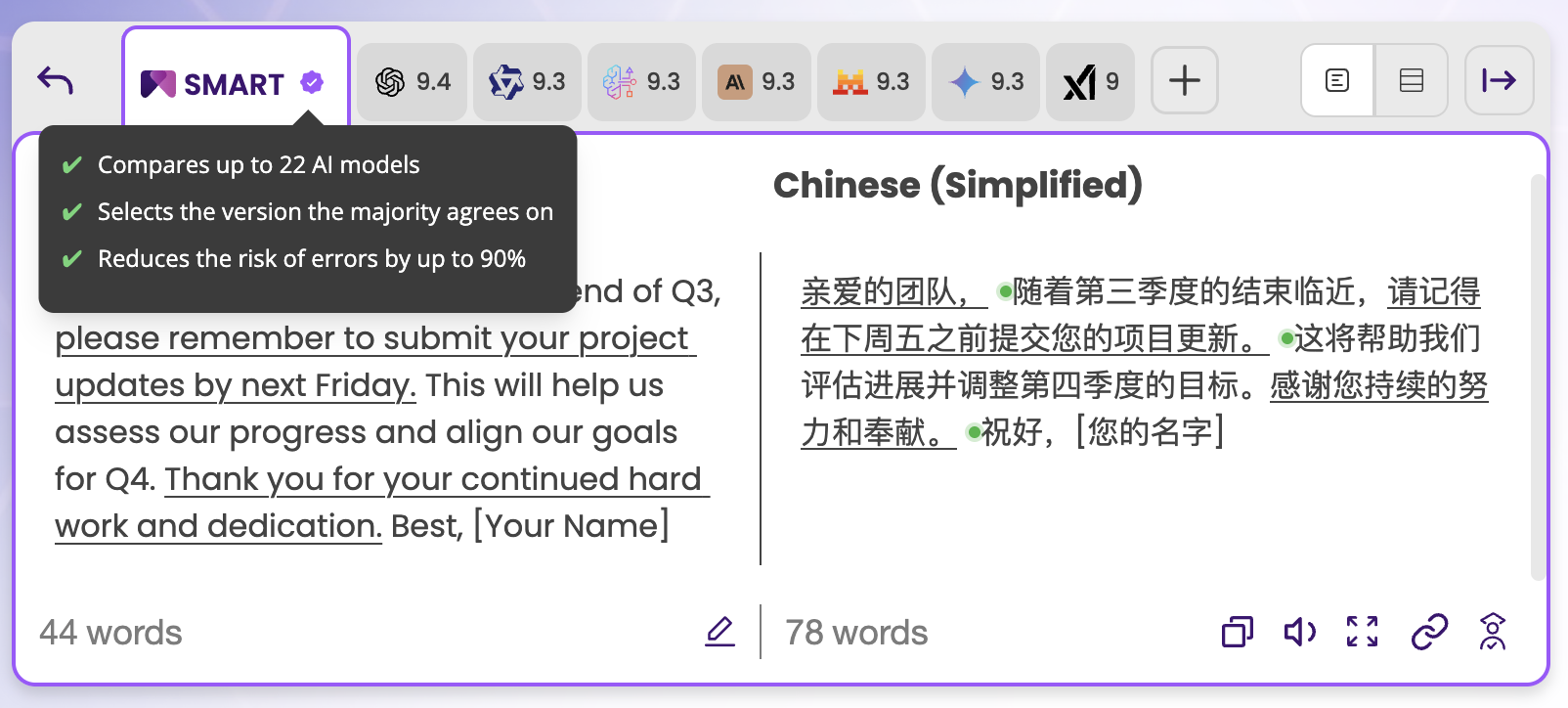
MachineTranslation.com's API routes requests through all 22 models simultaneously (including both Grok and ChatGPT) and returns the SMART consensus output. For developers who need verified translation quality at scale, a single API call replaces the need to manage, evaluate, and compare multiple engine integrations independently.
For an overview of translation API options and pricing: Translation API comparison.
Which tool is better for which type of translation?
Use Grok 4.1 for:
- Current-events content, news articles, and press releases where up-to-date context matters
- Translating material with emerging terminology or recently coined industry language
- High-volume, lower-stakes translation where cost-per-token is the primary concern
- Content referencing recent cultural events or social media language patterns
Use ChatGPT (GPT-5.4) for:
- Technical, scientific, and professional content where structured accuracy matters
- Legal, financial, or medical text with established terminology
- Long-form documents where reasoning coherence across the full text is important
- Any context where GPT's broad ecosystem integrations (Word, Notion, Zapier, etc.) are already in use
In both cases: Neither tool verifies its own output, and neither provides a confidence signal before you send the translation.
What do you do when accuracy has to be certain?
Grok and ChatGPT both produce useful translations. They fail in the same structural way: a single model cannot catch the errors it produces. When Grok misrenders a legal term or ChatGPT hallucinated two sentences in the middle of a technical document (as it did in MachineTranslation.com's internal 5,000-word benchmark) there is nothing in the output to tell you where it happened.
That is the problem MachineTranslation.com's SMART mechanism solves by design. SMART runs every translation through 22 AI models simultaneously (including Grok and ChatGPT among them) then applies a consensus audit: the translation that the majority of models agree on is selected. Because translation hallucinations are model-specific, cross-model agreement structurally filters them out.
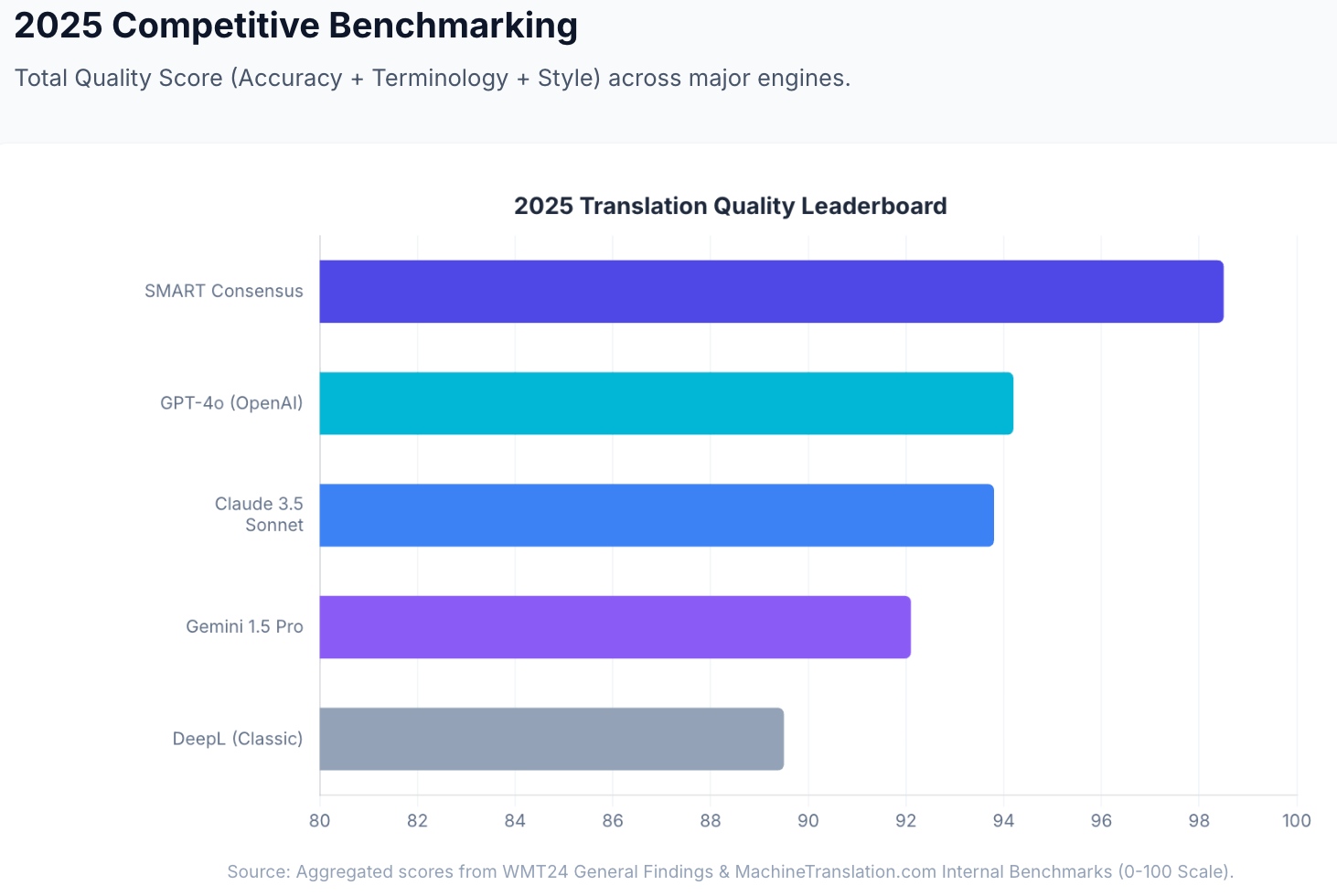
Internal benchmarks show the SMART consensus approach achieves an aggregated quality score of 98.5 out of 100 (compared to GPT-4o at 94.2 in the same benchmark set) and reduces critical translation error risk by 90%. Translations run through SMART reduce critical errors to under 2%, compared to the 10–18% hallucination rate for single-model LLMs, including Grok and ChatGPT. (Source: MachineTranslation.com internal reports; Intento State of Translation Automation 2025; WMT24 General Machine Translation Findings.)
For translations that need absolute certainty (legal submissions, clinical documentation, regulatory filings), human verification is available within the same platform. No external agency. 100% accuracy guaranteed.
Start translating at MachineTranslation.com — free, no sign-up required. Run Grok, ChatGPT, and 20 other AI models simultaneously and get the translation they agree on.
FAQs
1. Is Grok better than ChatGPT for translation?
Neither is definitively better across all translation tasks. Grok 4.1 has a specific advantage for translating current-events content and material involving emerging terminology, due to its real-time web and X data integration. ChatGPT (GPT-5.4) leads on structured accuracy benchmarks and is stronger for technical, scientific, and legal text. Both share the same core limitation: as single-model systems, neither can verify its own output.
2. Can Grok translate documents?
Grok can translate pasted text and, depending on the plan, uploaded documents. However, it is not a dedicated translation tool and does not offer features like original layout preservation, translation quality scoring, or cross-model verification. For document translation with layout preserved, MachineTranslation.com supports files up to 30MB across PDF, DOCX, TXT, CSV, XLSX, and image formats.
3. How accurate is ChatGPT for translation in 2026?
In MachineTranslation.com's internal benchmark across 5,000 words of mixed technical and marketing content, ChatGPT scored 89.8% accuracy — strong, but it hallucinated content in two sentences during the same test. On scientific reasoning benchmarks (GPQA Diamond), GPT-5.4 scores 92.0%. Like all single-model LLMs, ChatGPT hallucinations occur at a rate of 10–18% on translation tasks according to Intento State of Translation Automation 2025 and WMT24 findings.
4. What is Grok's pricing in 2026?
Grok is accessible via X Premium+ ($22/month) or SuperGrok ($30/month) for consumer use. The xAI API (Grok 4.1) is priced at $0.20 per 1 million input tokens and $0.50 per 1 million output tokens, one of the lowest API rates among major LLMs.
5. Does MachineTranslation.com use Grok and ChatGPT?
Yes. Both Grok and ChatGPT are among the 22 AI models that MachineTranslation.com runs simultaneously through its SMART system. Rather than relying on either tool alone, SMART selects the translation that the majority of 22 models agree on — capturing the strengths of each while filtering out model-specific errors. The full model list includes ChatGPT, Claude, Gemini, DeepL, Google, Grok, and 16 others.
6. Which AI tool is better for legal or medical translation?
For regulated content, neither Grok nor ChatGPT alone is sufficient — both produce hallucinations at a rate of 10–18% on translation tasks, which is a direct liability for legal and medical documents. MachineTranslation.com's SMART consensus reduces that error rate to under 2%, and human verification is available in the same platform with a 100% accuracy guarantee for content that requires it.
Translate with Grok, ChatGPT, and 20 other AI models simultaneously at MachineTranslation.com — free, no sign-up required.