April 22, 2026
English to German translation for business: Common mistakes and how to avoid them
The contract landed on your client's desk in Frankfurt, and it looked fine to you. But the procurement team in Munich flagged three terms that carried different meanings in their industry context, the level of formality signalled that you were treating them like a consumer rather than a corporate partner, and one sentence (perfectly clear in English) read as ambiguous under German contract law.
None of these were typos. They were translation decisions, made quickly, without a framework for what German business communication actually requires.
German is the most widely spoken native language in the European Union and the working language of the DACH region (Germany, Austria, and Switzerland) which together represent one of the largest economic zones in the world. Getting English to German translation right for business is not just a language task. It is a professionalism signal, a legal instrument, and in regulated industries, a compliance requirement.
This guide covers the six mistakes that most frequently damage business translation from English to German, why they happen, and the specific decisions that prevent each one.
Table of contents
Why the DACH market punishes translation errors more than most
Mistake 1: Misjudging register – formal vs. informal address
Mistake 2: Translating compound nouns literally
Mistake 3: Carrying English sentence structure into German
Mistake 4: Letting terminology drift across documents
Mistake 5: Ignoring DACH regional variants
Mistake 6: Publishing raw machine translation output without review
A practical workflow checklist for English to German business translation
How MachineTranslation.com handles English to German translation
FAQs
Why the DACH market punishes translation errors more than most
German business culture places a premium on precision and preparation. A poorly worded proposal signals disorganisation. Inconsistent terminology in a technical manual signals corner-cutting. Informal address in a formal B2B contract signals unfamiliarity with professional norms.
This matters beyond perception. Germany has extensive consumer protection, product liability, and contract law that creates real legal exposure when translations are inaccurate. Instructions for use, warranty terms, and safety documentation must meet specific standards – and an error that reads as minor in English can change the meaning of a clause in ways that affect enforceability.
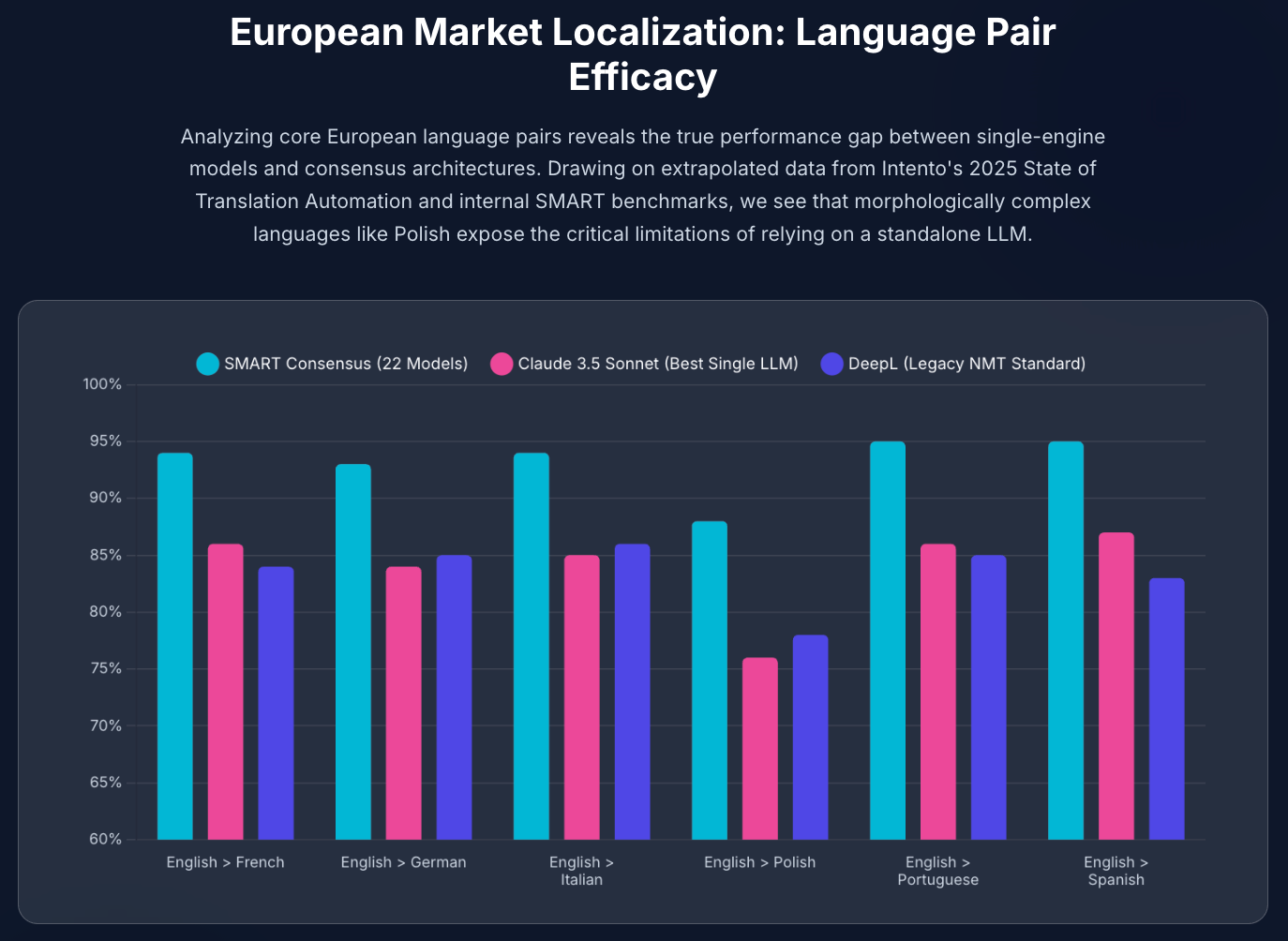
For businesses entering or scaling in the DACH market, the question is not whether to invest in quality English to German translation. It is which specific decisions to get right before something goes wrong.
Mistake 1: Misjudging register – formal vs. informal address
German has two second-person pronouns: Sie (formal) and du (informal). In B2B communication (proposals, contracts, technical documentation, customer service correspondence) Sie is the default professional standard in Germany. Using du in the wrong context signals either extreme informality or unfamiliarity with German business norms.
The challenge for businesses is that English has no equivalent distinction. "You" works everywhere in English, which means translators and MT systems must make a register decision that the source text does not signal.
Several large technology companies have defaulted to du in their German interfaces and marketing – some intentionally as a brand strategy, others by accident. The latter group has frequently faced pushback from enterprise customers who interpreted the choice as unprofessional.
The rule for most B2B contexts: use Sie throughout, consistently, and specify this explicitly in your translation brief. If your product is consumer-facing and deliberately casual, document that choice and apply it consistently – mixed register within a single document is the worst outcome.
Austria follows similar conventions to Germany. In Switzerland, the norms are similar but regional Swiss German vocabulary introduces additional variables worth knowing before you start.
Mistake 2: Translating compound nouns literally
German creates compound nouns by joining words together without spaces: Kraftfahrzeughaftpflichtversicherung (motor vehicle liability insurance), Datenschutzgrundverordnung (General Data Protection Regulation), Qualitätssicherungsmaßnahmen (quality assurance measures). This is not an edge case. It is a structural feature of German that applies across industries.
Machine translation systems frequently break these down into multi-word phrases when the compound does not appear in their training data, or they calque the English structure and produce something a native German speaker would immediately identify as non-native. A technical manual that renders Sicherheitsventildruckabfall as "security valve pressure drop" rather than one precise compound term signals that the document was not authored or reviewed by a German technical specialist.
The solution is a domain-specific glossary built before translation begins. Every industry has standard compound terms (legal, medical, engineering, financial) and those terms must be fixed in advance. Translation memory systems and terminology management tools exist precisely for this purpose. Without them, even an experienced translator working at volume will introduce variation.
Mistake 3: Carrying English sentence structure into German
English follows a subject-verb-object pattern. German is more flexible, but in subordinate clauses the verb moves to the end – a structural rule that affects how complex sentences are parsed and understood.
In legal and technical documents, where subordinate clauses are common, this matters. A sentence like "The contractor agrees that the deliverables will be submitted by the agreed deadline" has a different syntactic rhythm in German, and a literal English structure produces a sentence that is grammatically marginal and stylistically foreign.
More practically: German business writing tends toward longer, more formal sentence structures than English. English business writing has been moving toward shorter, plainer sentences for decades. When you apply that English register to a German translation, you can produce text that reads as blunt or underdeveloped by German professional standards.
Human reviewers with native-level German proficiency catch these issues. MT post-editors trained specifically for the language pair catch them at scale. Neither outcome is achievable if translation is treated as a bulk commodity task.
Mistake 4: Letting terminology drift across documents
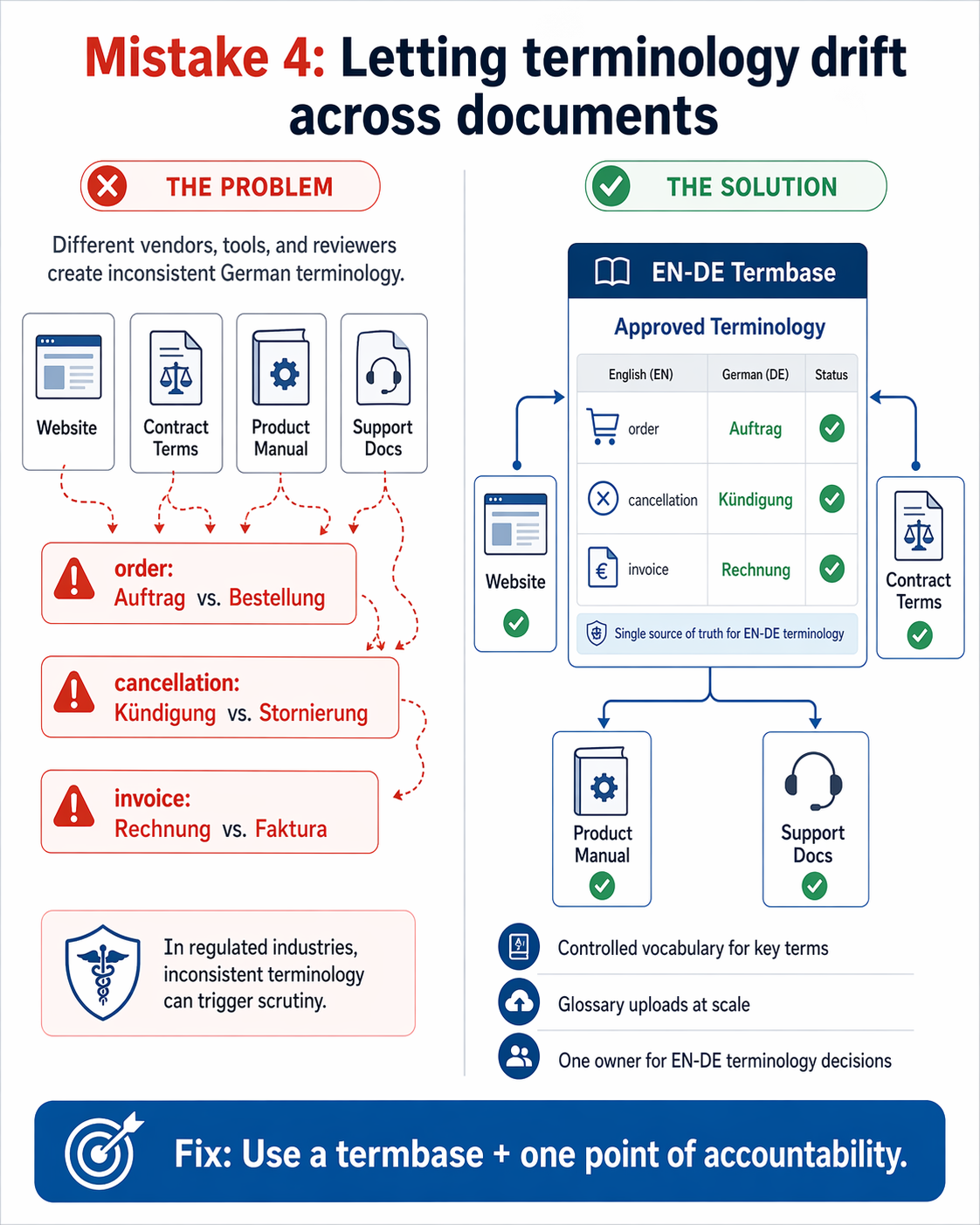
A company that translates its website, its contract terms, its product manual, and its customer support documentation separately (using different vendors, different tools, or different reviewers at different times) will almost certainly end up with inconsistent German terminology.
Auftrag vs. Bestellung for "order." Kündigung vs. Stornierung for "cancellation." Rechnung vs. Faktura for "invoice." These pairs are not interchangeable in all contexts, and using them interchangeably signals to a German reader that the company has not coordinated its communications.
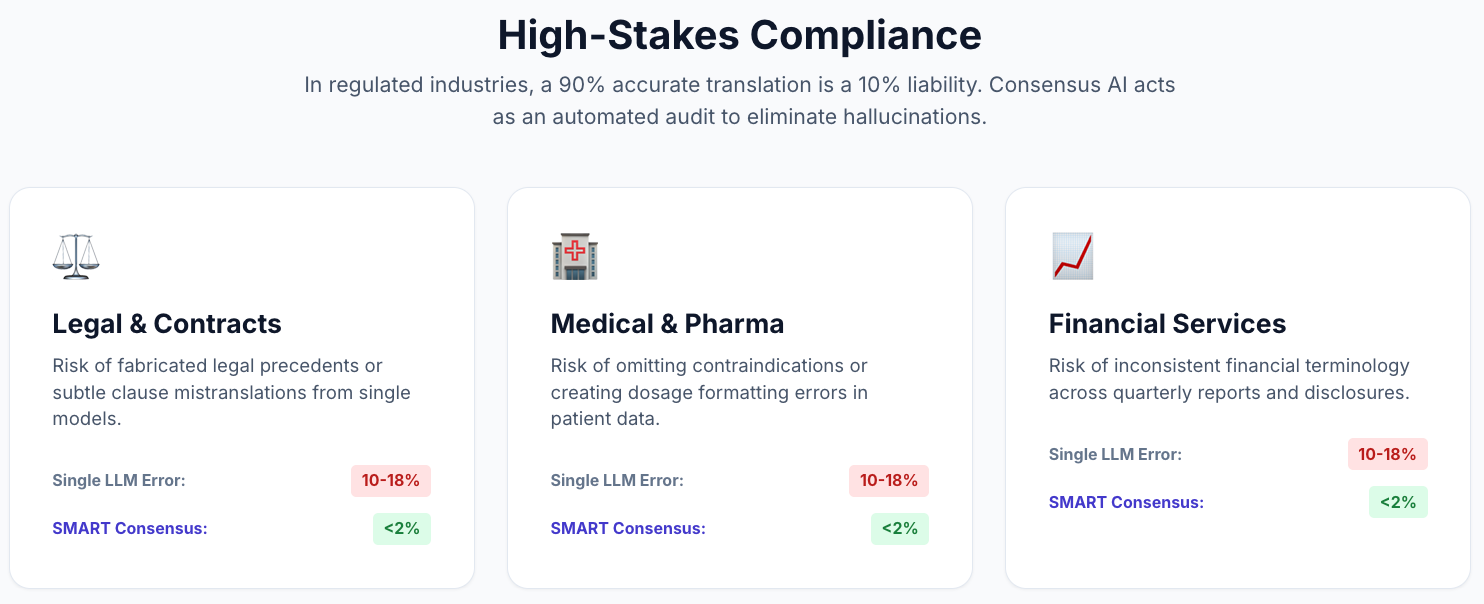
In regulated industries, terminology inconsistency is not just a style problem. If a medical device manual uses two different terms for the same component, that inconsistency can attract scrutiny from regulatory reviewers.
The technical answer is a termbase, a controlled vocabulary of approved translations for key terms, applied consistently across all content. MT platforms that support glossary uploads make this tractable at scale. The organisational answer is a single point of accountability for EN-DE terminology decisions, rather than leaving it to each project team to resolve independently.
Mistake 5: Ignoring DACH regional variants
German is the official language of Germany, Austria, and Switzerland, but these markets use different vocabulary in specific domains. Austrian German has distinct terms for food labelling, administrative processes, and some legal concepts. Swiss German orthography differs slightly, Switzerland does not use the ß character, replacing it with ss throughout.
For most business content, standard German (Hochdeutsch) is appropriate across all three markets. But for product labelling, regulatory submissions, government-facing documents, or consumer marketing, regional targeting matters.
The mistake is not knowing which standard applies. A product manual submitted to Austrian regulatory authorities in German-German standard, or a Swiss label using ß, will be flagged. The fix is specifying the target market in the translation brief – not as an afterthought, but as a mandatory input before the first word is translated.
Mistake 6: Publishing raw machine translation output without review
Machine translation quality for English to German has improved substantially. For high-frequency domains (general business correspondence, technical documentation with controlled vocabulary, e-commerce product descriptions), modern neural MT systems produce output that is usable with targeted post-editing.
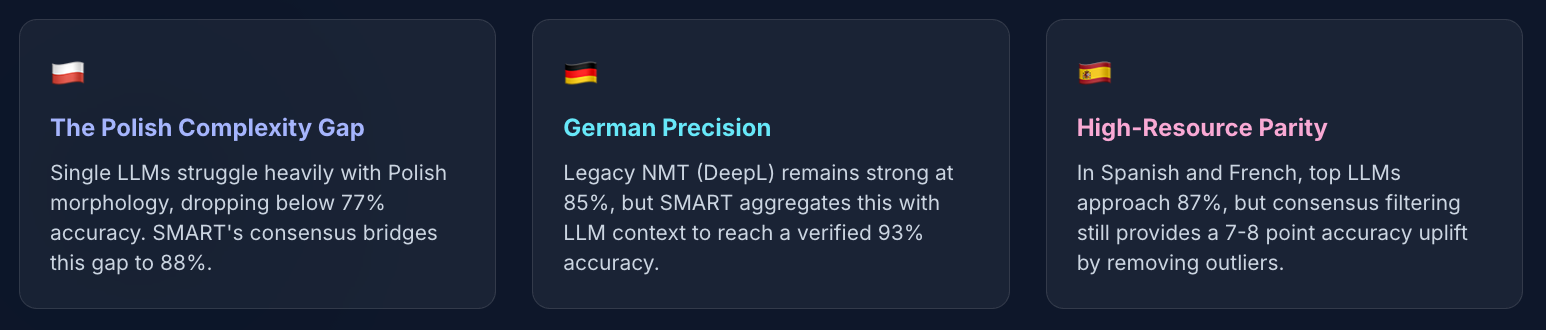
The mistake is treating "usable with post-editing" as the same as "publish-ready without review." The failure modes of MT in English to German are specific and predictable: register errors (the Sie/du problem), compound noun fragmentation, idiomatic phrases translated literally, and subtle shifts in legal or technical meaning that are syntactically correct but semantically wrong.
A qualified post-editor reviewing MT output for English to German will catch these in a fraction of the time it takes to translate from scratch. The economics are strongly in favour of MT plus post-edit for volume content. The economics are not in favour of MT with no review for any content that a German business partner, customer, or regulator will read.
A practical workflow checklist for English to German business translation
Before translation
Define the target market: Germany, Austria, Switzerland, or all three
Specify register: Sie (formal) or du (informal) – document the decision
Build or update the domain-specific termbase with approved translations for key terms
Provide context documents (brand guidelines, previous translations, style guides) to the translator or MT system
During translation
Apply the termbase – glossary upload if using MT, term check if using human translators
Flag any source text with ambiguous register, idioms, or culturally-specific references for review before proceeding
Review
Native-speaker review by someone with domain expertise, not just language proficiency
Terminology consistency check against the termbase
Register consistency check – Sie/du applied uniformly throughout the document
Before publishing
Legal or compliance sign-off for contracts, regulatory filings, and medical or safety documentation
How MachineTranslation.com handles English to German translation
MachineTranslation.com's English to German translation tool combines neural MT with post-editing support designed for business content. The platform supports glossary uploads, enabling businesses to enforce consistent terminology across all EN-DE translation projects rather than rebuilding terminology decisions from scratch on each project.
For formality, MachineTranslation.com allows users to specify formal or informal register before translation begins – addressing the Sie/du decision systematically rather than leaving it to default MT behaviour.
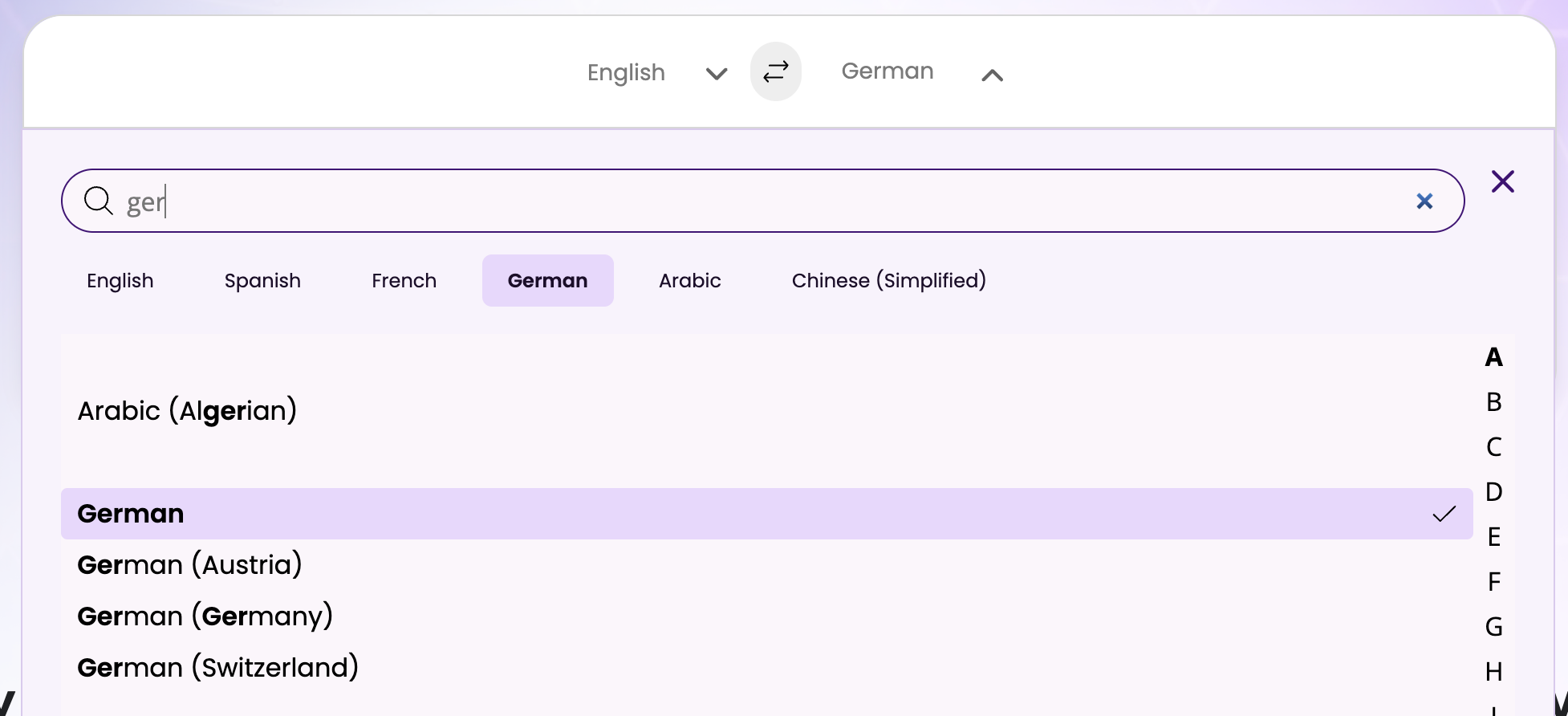
The platform also supports multiple AI models, allowing quality comparison across providers for a given text before committing to a final output. For businesses managing ongoing EN-DE translation volume, this creates a repeatable quality baseline rather than relying on single-provider output.
FAQs
1. What is the most common mistake in English to German business translation?
Register errors (specifically, using the informal du address in formal B2B contexts) are among the most frequently cited issues by German business readers. They are also among the easiest to prevent: specify Sie in the translation brief and verify consistency during review.
2. Is machine translation accurate enough for English to German business documents?
For many content types (technical documentation, product descriptions, internal communications), modern neural MT systems produce English to German output accurate enough for production use with targeted post-editing. For legal documents, regulatory filings, and any content where precise meaning has contractual or compliance implications, MT should be treated as a first draft requiring expert review, not a finished output.
3. Do I need different German translations for Germany, Austria, and Switzerland?
For most business content, standard German (Hochdeutsch) is appropriate across all three markets. Regional variants become important for product labelling, regulatory submissions, government-facing documents, and consumer marketing where local vocabulary or legal standards differ. Specify the target market in your translation brief so the translator or MT system can apply the appropriate standard.
4. How do I ensure terminology consistency across multiple German documents?
Build a termbase (a controlled vocabulary of approved English-to-German translations for key terms in your domain) and apply it consistently across all translation projects. MT platforms that support glossary uploads enforce this systematically. Without a termbase, terminology drift across documents is nearly inevitable, especially when multiple vendors or reviewers are involved.
5. What should I include in a translation brief for English to German business content?
A complete brief includes: target market (Germany, Austria, Switzerland), register (Sie or du), domain-specific termbases, context documents such as brand guidelines and style guides, content type (marketing, legal, technical), and any terms that must remain in English. The clearer the brief, the fewer revision rounds the translation requires.