April 16, 2026
Despacito meaning and translation: what AI gets right and what it misses
The title of "Despacito" translates to a single English word: "slowly." If you know that and nothing else about the song, you know almost nothing about it. The word despacito (a diminutive form of despacio) carries a softness and intimacy in Spanish that the English "slowly" does not. And the song that word titles is not really about pace at all. It is about closeness, patience, and desire, expressed through a language whose sonic and cultural texture is integral to the meaning.
This makes "Despacito" a useful case study in what AI translation gets right about creative content, where it falls short, and why multi-model comparison reveals things a single translation cannot.
In this article
- What does despacito mean in Spanish?
- The song's themes and what makes them translation-resistant
- Language and cultural significance: Spanish, the bilingual remix, and global reach
- How AI handles Despacito's lyrics: where models agree and where they diverge
- Why creative translation is harder for AI than factual content
- Controversies and cultural reception
- FAQs
What does despacito mean in Spanish?
Despacito is a Spanish adverb meaning "slowly" or "gently." It is the diminutive form of despacio (slow), and the diminutive suffix "-ito" adds a quality of tenderness and smallness that the plain English word "slowly" does not carry. In everyday Spanish, you might hear it used to ask someone to slow down or speak more softly: "Habla despacito" means "Speak slowly."
In the song, the word is used not as a speed instruction but as an emotional orientation. The entire lyrical structure describes an approach to intimacy that is deliberate, attentive, and unhurried. The word contains the song's argument.
This is already a translation problem. A dictionary renders despacito as "slowly." A culturally informed translator renders it as something closer to "gently, attentively, without rushing" and then asks what English phrase carries that emotional register for the intended audience. Those are different tasks, and they produce different outputs.
The song's themes and what makes them translation-resistant
"Despacito" was written by Luis Fonsi, Daddy Yankee, and Erika Ender, and released in January 2017. It blends reggaeton and Latin pop, and its lyrics describe a slow, deliberate romantic encounter built around physical closeness and attentiveness.
The specific translation challenge the lyrics present is not vocabulary. The words are not obscure or technical. The challenge is register: the song uses straightforward Spanish words to construct an emotional and sensory atmosphere that is culturally specific to the Latin pop tradition. Phrases that are intimate without being crude in Spanish can land differently in a literal English rendering. The warmth of the original relies partly on the musicality of the Spanish itself and partly on the cultural frame the listener brings to it.
According to MachineTranslation.com's internal analysis of how AI translation errors have evolved, surface-level errors (syntax, grammar, word order) have dropped to near zero with modern LLMs. The remaining errors are almost exclusively semantic: wrong tone, wrong register, wrong emotional weight. For a song like "Despacito," where the tone is the content, those semantic errors are the only ones that matter.
Language and cultural significance: Spanish, the bilingual remix, and global reach
"Despacito" was originally performed entirely in Spanish and became a global hit before Justin Bieber joined for a remix version that introduced English lyrics. That remix trajectory is itself a lesson in creative localisation vs. literal translation.
The English verses Bieber contributed were not translations of the Spanish lyrics. They were new creative content written for a different audience in a different linguistic register. A professional localisation team made the judgement that the Spanish lyrics, translated literally into English, would not produce the same effect for English-speaking listeners. They wrote something new that served the same emotional function.
This is the distinction between translation and localisation that AI tools are only beginning to approach. A system that renders the Spanish lyrics accurately into English produces a factually correct document. A localised version produces something that resonates with its target audience the way the original resonated with its own. The Bieber remix is a real-world example of human creatives choosing localisation over translation, and understanding why.
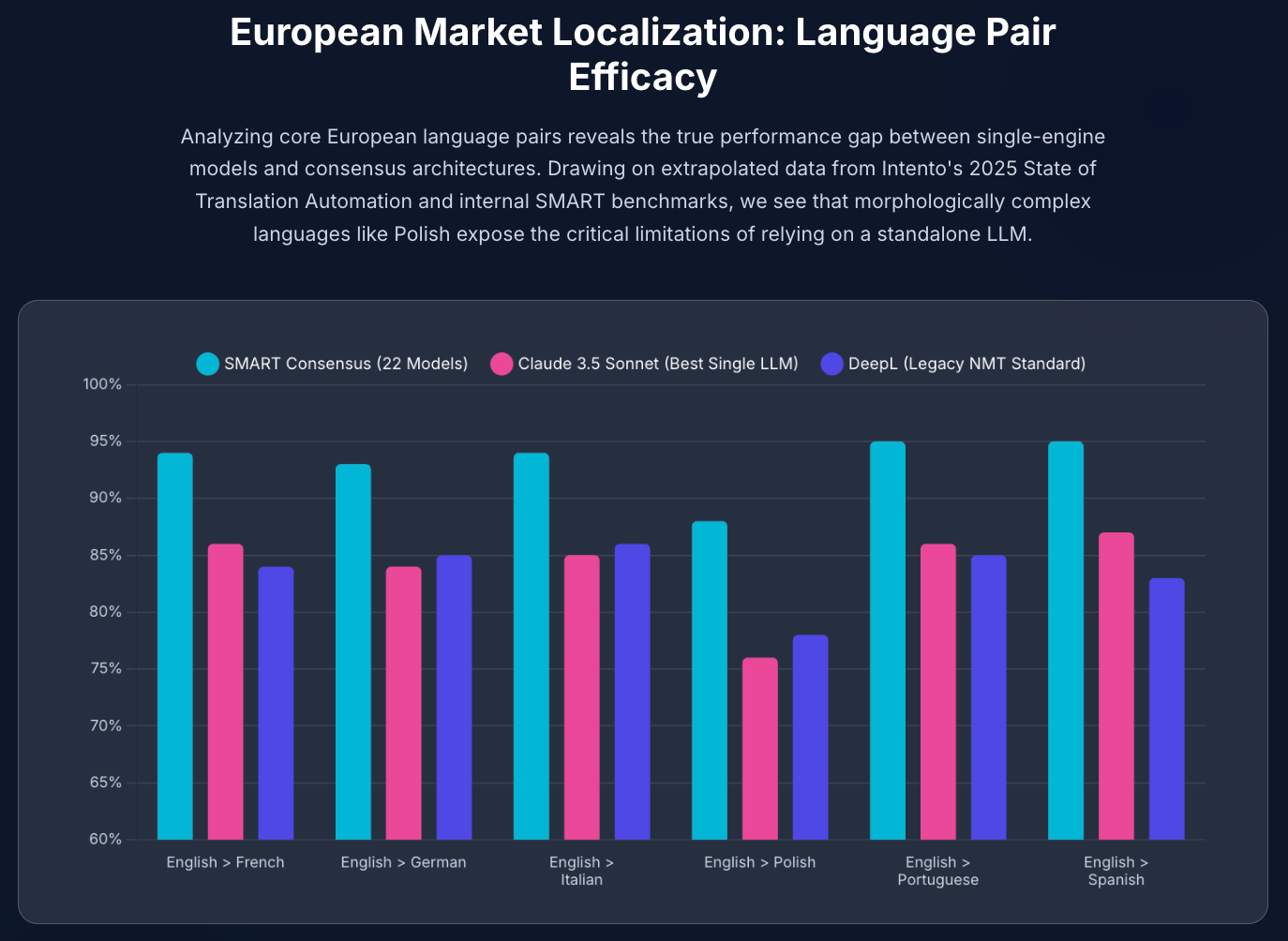
Spanish is one of the two or three languages where AI translation currently performs at its highest level. According to internal benchmarks from MachineTranslation.com, a consensus approach across 22 models maintains 93 to 95% accuracy for Spanish across Western and Southern European language pairs — compared to the 84 to 87% plateau that top single LLMs reach due to terminology drift and formatting errors (source: Tomedes and Lokalise AI Translation Quality Research, 2025). Even at its best technical performance, the remaining gap is in the semantic layer — exactly the layer where a song like "Despacito" lives.
"Despacito" topped charts in more than 40 countries and became the first Latin song to achieve Diamond certification by the RIAA, reflecting over 10 million sales and streams in the United States. It held the record for the most-viewed video on YouTube for several years after its release. Its global reach is in part a product of its musical accessibility across language barriers, but also of the deliberate decision to keep the song primarily in Spanish rather than translating it for international markets.
How AI handles Despacito's lyrics: where models agree and where they diverge
When MachineTranslation.com runs a translation, it sends the text through 22 AI models simultaneously, including ChatGPT, Claude, Gemini, DeepL, Google, and 17 others, and surfaces all outputs with quality scores. For factual or technical content, the models tend to converge: the same meaning is rendered with minor phrasing differences. For creative and culturally embedded content, they diverge in ways that are revealing.
For a song like "Despacito," the divergence is not an error. It is a signal. When some models render an intimate Spanish phrase with clinical precision and others render it with more warmth and idiomaticity, the difference reflects a genuine interpretive choice about which dimension of meaning to prioritise. Seeing both outputs is more useful than seeing only one, because it shows you the translation latitude in the original.
SMART, MachineTranslation.com's consensus mechanism, selects the translation that the majority of models agree on. For music and creative content, this means the output that most models converge on is the most interpretively stable reading. The alternatives that SMART also surfaces show where models diverge, which for creative content is where the cultural translation challenge actually lives.
As noted in internal research from MachineTranslation.com, users who switched to SMART spent on average 27% less time choosing between outputs, because the consensus mechanism removes the low-confidence variation and surfaces the most defensible interpretation first. For creative content, this is the starting point for a human translator or editor to refine, not the finished product.
In an internal joke-test across 30 jokes with 8 engines on MachineTranslation.com, translations that used candidate terms combined with human review preserved humor in 32% more cases than default engine outputs. The same principle applies to song lyrics: creative content where tone and cultural resonance are primary requires multi-model comparison as a starting point and human judgement at the finish.
Why creative translation is harder for AI than factual content
For technical, legal, or informational content, there is generally a correct translation. For creative content, there are multiple valid renderings, each of which makes different trade-offs between literal fidelity, tonal register, cultural resonance, and target audience expectations.
Song lyrics amplify this because they are also constrained by rhythm and sonic texture. A phrase that fits the melody in Spanish may not fit any natural English equivalent. The translator faces a three-way trade-off between meaning, sound, and culture.
Current AI models handle the meaning dimension reasonably well for major language pairs like Spanish. The sonic dimension (how the words sound and flow) and the cultural dimension (how the words land for the target audience) are where single models still fall short. This is not primarily a failure of capability but of architecture: a single model makes one set of trade-off decisions and presents them as the answer. It cannot show you the range of defensible trade-offs.
This is why the multi-model comparison approach is particularly suited to creative translation. The value is not just in getting a better first draft: it is in seeing the interpretive range, understanding where models agree (the more constrained passages) and where they diverge (the culturally loaded or register-sensitive passages), and using that information to make a more informed editorial decision.
Creative content loses its power the moment it sounds translated. MachineTranslation.com runs 22 AI models against your content and surfaces the version that preserves what you meant, not just what you said.
Controversies and cultural reception
"Despacito" attracted significant cultural debate alongside its commercial success. Malaysia banned the song from state-owned radio and television following complaints about the sexual content of its lyrics. The ban prompted broader discussion about whether content standards applied differently to Spanish-language material than to English-language material with comparable themes.
Critics also raised questions about whether the song's international success reinforced a limited or stereotyped version of Latin culture for global audiences, particularly given that the song's explicit content was less visible to non-Spanish-speaking listeners who responded primarily to its rhythm and melody rather than its lyrics.
These reception differences are themselves a translation observation. A significant portion of the song's non-Spanish-speaking audience was effectively experiencing it in a kind of pre-translation state: responding to sound and rhythm while the semantic content remained inaccessible without effort. The song's global reach was partly a product of that inaccessibility, which is an ironic inversion of the usual goal of translation.
The song's impact in Puerto Rico, where Luis Fonsi is from, also extended beyond music. Reports from Puerto Rico described a 45% increase in tourist interest in the country following the song's success, partly because its music video showcased specific locations including La Perla in Old San Juan and Club La Factoría. The cultural export function of music is in this case also a localisation story: the video's settings were legible to international audiences as generically "tropical and vibrant" while carrying specific meaning for Puerto Rican viewers.
FAQs
1. What does despacito mean in English?
Despacito translates to "slowly" or "gently" in English. It is the diminutive form of despacio, and the diminutive suffix adds a quality of tenderness that the plain English "slowly" does not carry. In the song, the word describes a deliberate, attentive approach to intimacy rather than pace in any literal sense.
2. Who wrote Despacito?
"Despacito" was written by Luis Fonsi, Daddy Yankee (Ramón Luis Ayala Rodríguez), and Erika Ender. It was released in January 2017. Justin Bieber later joined for a remix that introduced English-language verses, which were new content written for an English-speaking audience rather than a translation of the original Spanish lyrics.
3. Can AI translate Despacito's lyrics accurately?
AI can render the literal Spanish vocabulary of the song's lyrics accurately into English. What it handles less consistently is the tonal register and cultural resonance, the qualities that make the lyrics feel intimate rather than clinical in Spanish. Different AI models make different trade-off decisions about how to render culturally embedded phrases, which is why comparing multiple models produces more useful information than relying on a single output.
4. Why is Despacito hard to translate?
The challenge is not vocabulary but register. The song's Spanish phrasing constructs a particular emotional and sensory atmosphere that depends partly on the musicality of the language and partly on the cultural context listeners bring. Translating the words accurately produces a document. Translating the feeling requires interpretive decisions about what the equivalent register sounds like in the target language and culture.
5. How does MachineTranslation.com handle creative translation?
MachineTranslation.com's SMART mechanism runs 22 AI models simultaneously and surfaces all outputs with quality scores, showing where models agree (more interpretively stable passages) and where they diverge (culturally loaded or register-sensitive passages). For creative content like song lyrics, the divergence is information about the translation challenge, not just a quality problem. Users see the consensus output and the alternatives, and can choose the rendering that best preserves the voice and intent of the original. Translate free at MachineTranslation.com, no sign-up required.
6. What language is Despacito in?
"Despacito" is primarily in Spanish, specifically Puerto Rican Spanish as spoken by Luis Fonsi. The Justin Bieber remix version added English verses, but the core of the song remains in Spanish. The decision to keep the original Spanish rather than producing a translated English version was a deliberate creative and commercial choice, and the song became a global hit in that form.
Translate Spanish content with 22 AI models at MachineTranslation.com, free, no sign-up required. See where models agree, see where they diverge, and choose the version that preserves what you meant.