April 16, 2026
DeepL vs Amazon Translate: which is right for your workflow?
If your translation workflow lives inside AWS, Amazon Translate is the obvious starting point — it plugs directly into your existing infrastructure, scales without a second thought, and charges only for what you use. But the moment accuracy matters (for a client-facing document, a legal filing, a product listing in a new market), the question shifts. DeepL's quality reputation exists for a reason. And the gap between its output and Amazon Translate's becomes visible exactly when the content is hardest to get right.
This comparison breaks down where each tool genuinely excels, where each one falls short, and what to use when you need both volume and accuracy to hold at the same time.
In this article
- What is DeepL?
- What is Amazon Translate?
- How do DeepL and Amazon Translate compare on accuracy?
- How do the language coverage options compare?
- How does pricing differ between DeepL and Amazon Translate?
- Which tool has the better API for developers?
- Which tool is better for which use case?
- What happens when accuracy and scale both matter?
- Frequently asked questions
What is DeepL?
DeepL is a neural machine translation service developed by DeepL GmbH, a company founded in 2009 in Cologne, Germany as the dictionary platform Linguee. Its dedicated translation engine launched in 2017, and today DeepL supports 33 languages — primarily European language pairs, along with Chinese, Japanese, and Korean.
DeepL's core positioning is quality and naturalness. Its translations are widely regarded as among the most fluent available for European language pairs, with a particular strength in capturing contextual nuance, idiomatic expressions, and tonal register. It has historically performed well on human evaluation benchmarks for languages like French, German, Spanish, and Italian. The Intento State of Translation Automation 2025 ranked DeepL next-gen among the best-performing real-time solutions across multiple European language pairs.
DeepL is available as a free web interface (limited to 1,500 characters per request and three document translations per month), as a paid subscription (DeepL Pro), and as an API for developers. Paid plans offer glossary management, CAT tool integration, data privacy controls under EU GDPR, and higher character limits. Pricing for paid plans runs from approximately $10.49/user/month (Starter) to $68.99/user/month (Ultimate), with enterprise pricing available on request.
What DeepL does well: European language quality, naturalness, contextual accuracy, document translation with layout preservation, tone adjustment for select languages.
Where DeepL is limited: Language coverage caps at 33 languages. Users working outside core European pairs often find quality inconsistent. No internal verification mechanism, the output of a single model is what you receive, with no confidence signal and no cross-model check.
What is Amazon Translate?
Amazon Translate is a neural machine translation service developed by Amazon Web Services (AWS). It supports 75 languages and is designed to operate as an infrastructure component — living inside AWS-based applications, content pipelines, and enterprise workflows rather than as a standalone translation interface.
Unlike DeepL, Amazon Translate is not primarily positioned on quality benchmarks. Its value proposition is throughput, integration, and cost efficiency at scale. Because it operates on a pay-per-character model with no minimum spend, it is a natural choice for businesses that need to translate large volumes of content (product descriptions, customer support tickets, user-generated content) where speed and cost predictability matter more than maximum linguistic precision.
Amazon Translate supports Active Custom Translation, which allows organizations to supply custom parallel data to adapt the engine's output to their specific terminology and domain. It integrates natively with other AWS services including S3, Lambda, and Comprehend, making it straightforward to embed in automated data pipelines.
What Amazon Translate does well: High-volume throughput, AWS ecosystem integration, pay-as-you-go cost control, custom terminology support, real-time translation APIs.
Where Amazon Translate is limited: Translation quality benchmarks consistently place it below DeepL for European language pairs. It is not designed for content where nuance, register, or professional fluency is the primary requirement.
How do DeepL and Amazon Translate compare on accuracy?
In MachineTranslation.com's internal benchmark across 5,000 words of mixed technical and marketing content, DeepL achieved 94.2% accuracy — the highest score in that test among standalone translation engines. Amazon Translate delivered consistent output at scale but ranked lower on quality scoring in the same evaluation.
The accuracy gap becomes most visible on content that is linguistically complex — marketing copy with idiomatic phrasing, legal text with precision-dependent terminology, or technical documentation requiring exact register. DeepL handles this category substantially better than Amazon Translate for its supported languages.
The important caveat: both are single-model systems. A single model cannot verify its own output. DeepL users on G2 and in professional translation communities describe manually re-checking high-stakes translations as a standard part of their workflow — not because DeepL is unreliable, but because there is no built-in signal to tell you when it has produced an outlier output. Amazon Translate has the same structural limitation at higher volume.
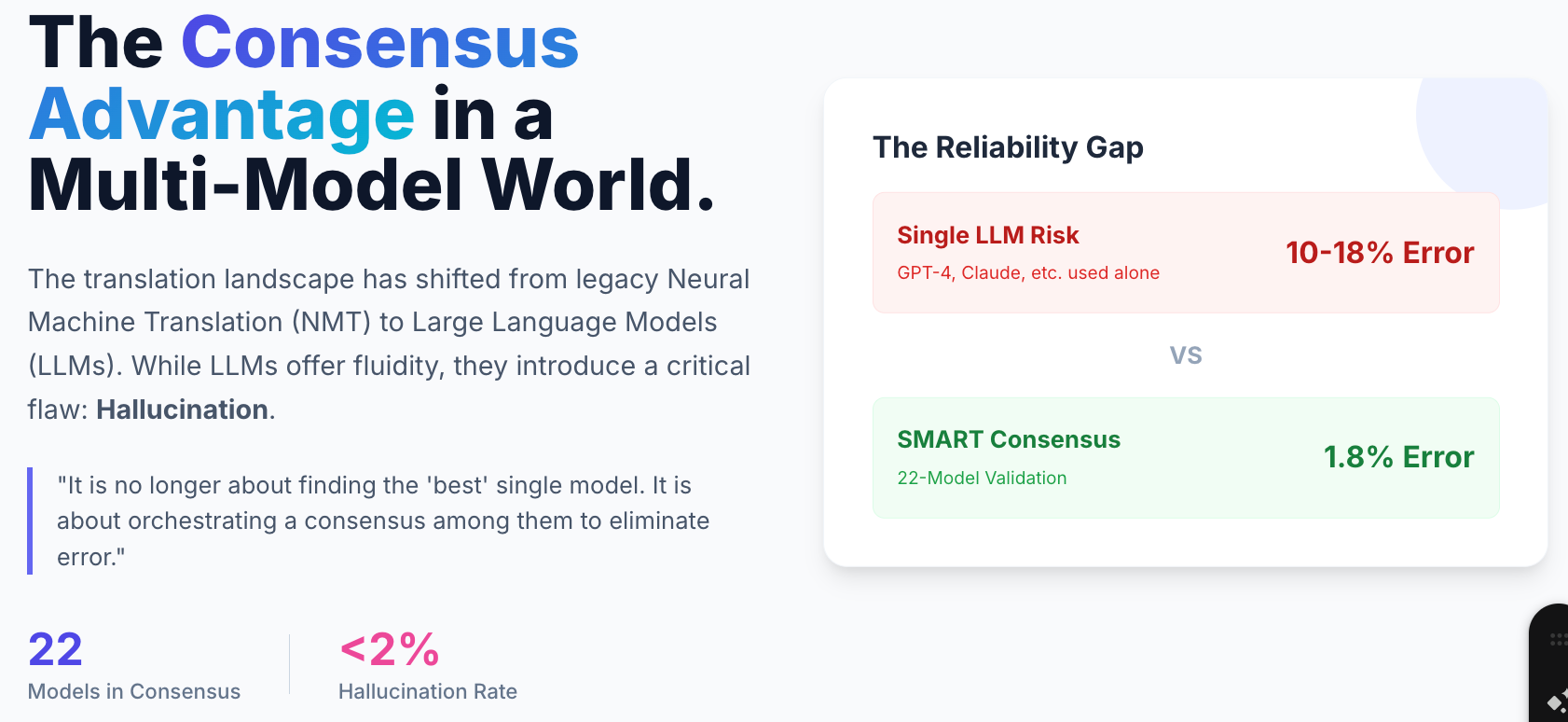
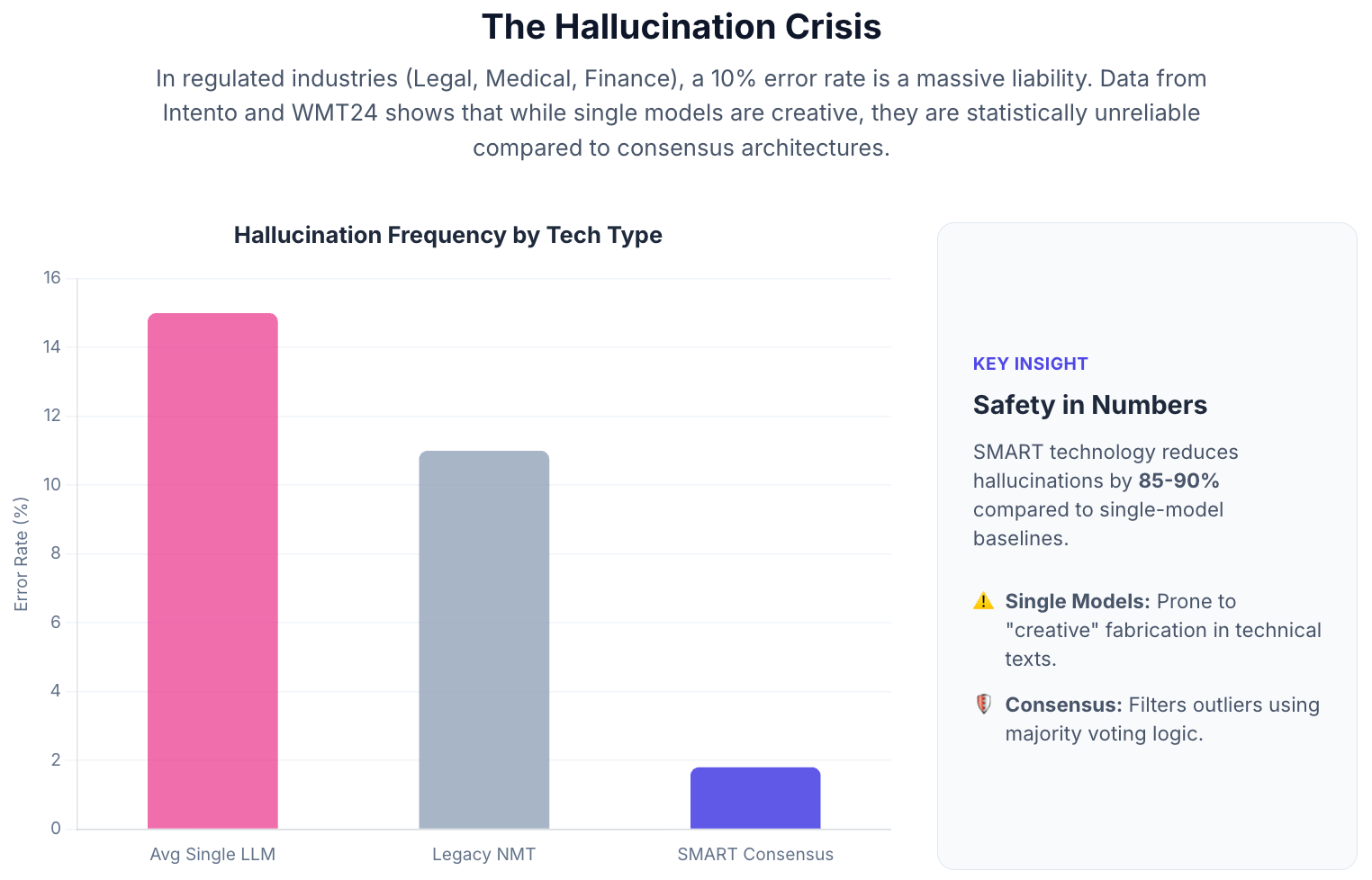
According to data synthesized from Intento's State of Translation Automation 2025 and internal benchmarks, individual top-tier translation models (including NMT engines and large language models) produce hallucination-level errors on between 10% and 18% of translation tasks. For professional or regulated content, that range is not acceptable.
| DeepL | Amazon Translate | |
|---|---|---|
| Accuracy focus | Quality and fluency | Throughput and integration |
| Language coverage | 33 languages | 75 languages |
| Custom terminology | Glossary support (paid plans) | Active Custom Translation |
| Error verification | Single-model output, no verification signal | Single-model output, no verification signal |
| Best for | European language quality, professional content | High-volume pipelines, AWS-integrated workflows |
How do the language coverage options compare?
DeepL supports 33 languages, concentrated in European pairs. This is sufficient for most Western European business use cases, but creates gaps for organizations operating in Asia-Pacific, Latin American markets beyond Spanish and Portuguese, or lower-resource language pairs.
Amazon Translate supports 75 languages, with broader coverage across Asian, Middle Eastern, and Southeast Asian languages. For businesses that need translation at scale across a diverse global footprint, Amazon Translate's language range is a practical advantage.
MachineTranslation.com covers 330+ languages, aggregating output from 22 AI models simultaneously (including both DeepL and Amazon Translate) and selecting the consensus output the majority of models agree on. For teams working across multiple markets, this eliminates the need to choose between tools for different language pairs.
For specific language pair guidance, see the MachineTranslation.com pages for English to Spanish, English to French, and English to German.
How does pricing differ between DeepL and Amazon Translate?
DeepL uses a subscription model. The free tier allows up to 1,500 characters per request and three document translations per month. Paid plans:
- Starter: ~$10.49/user/month
- Advanced: ~$34.49/user/month
- Ultimate: ~$68.99/user/month
- Enterprise: custom pricing
For teams translating millions of characters per month, DeepL's per-seat pricing can scale steeply.
Amazon Translate charges per character on a pay-as-you-go basis. There is no monthly seat fee. For large-volume pipelines where the same infrastructure is already running on AWS, the cost-per-unit is low and predictable. However, volume pricing at enterprise scale should be confirmed directly with AWS, as character rates and free-tier eligibility vary by region and account tier.
MachineTranslation.com offers individuals and teams access to consensus output from 22 models (including both DeepL and Amazon Translate) at no cost for most use cases.
Which tool has the better API for developers?
Amazon Translate's API is part of the AWS SDK and integrates natively with S3, Lambda, and other AWS services. For development teams already working within the AWS ecosystem, this is a significant operational advantage. The API supports asynchronous batch translation jobs, custom terminology injection, and real-time translation endpoints.
DeepL's API is available on paid plans. It is purpose-built for quality, offering glossary support, formality settings, and HTML tag handling. For applications where translation output is user-facing and quality is the priority, DeepL's API is a strong choice. It is not designed for the kind of high-throughput automated pipeline that Amazon Translate handles natively.
MachineTranslation.com's API routes requests through all 22 models simultaneously, including DeepL and Amazon Translate, and returns the SMART consensus output — the translation the majority of models agreed on. Developers who need to integrate quality-verified translation at scale can access a single API endpoint rather than managing multiple engine integrations.
Which tool is better for which use case?
Choose DeepL if:
- Your content is primarily in European languages
- Quality and naturalness are the primary requirement
- You are working in professional, client-facing, or regulated content categories
- You need glossary management and CAT tool integration
Choose Amazon Translate if:
- Your workflow lives inside AWS and integration simplicity is critical
- You are translating at very high volume with cost-per-character as the key metric
- Your language coverage needs extend beyond DeepL's 33 supported languages
- You need real-time translation embedded in applications or data pipelines
What happens when accuracy and scale both matter?
The DeepL vs. Amazon Translate decision presents a real trade-off: DeepL offers better quality for European languages but caps at 33 languages and prices by subscription. Amazon Translate offers broader language coverage and AWS-native scale but ranks lower on accuracy benchmarks for professional content.
That trade-off matters less when you have a way to check both.
MachineTranslation.com's SMART mechanism runs every translation through 22 AI models simultaneously (including DeepL and Amazon Translate among them) then applies a consensus audit: the output that the majority of models agree on is selected. Because translation hallucinations are model-specific, cross-model agreement structurally filters them out.
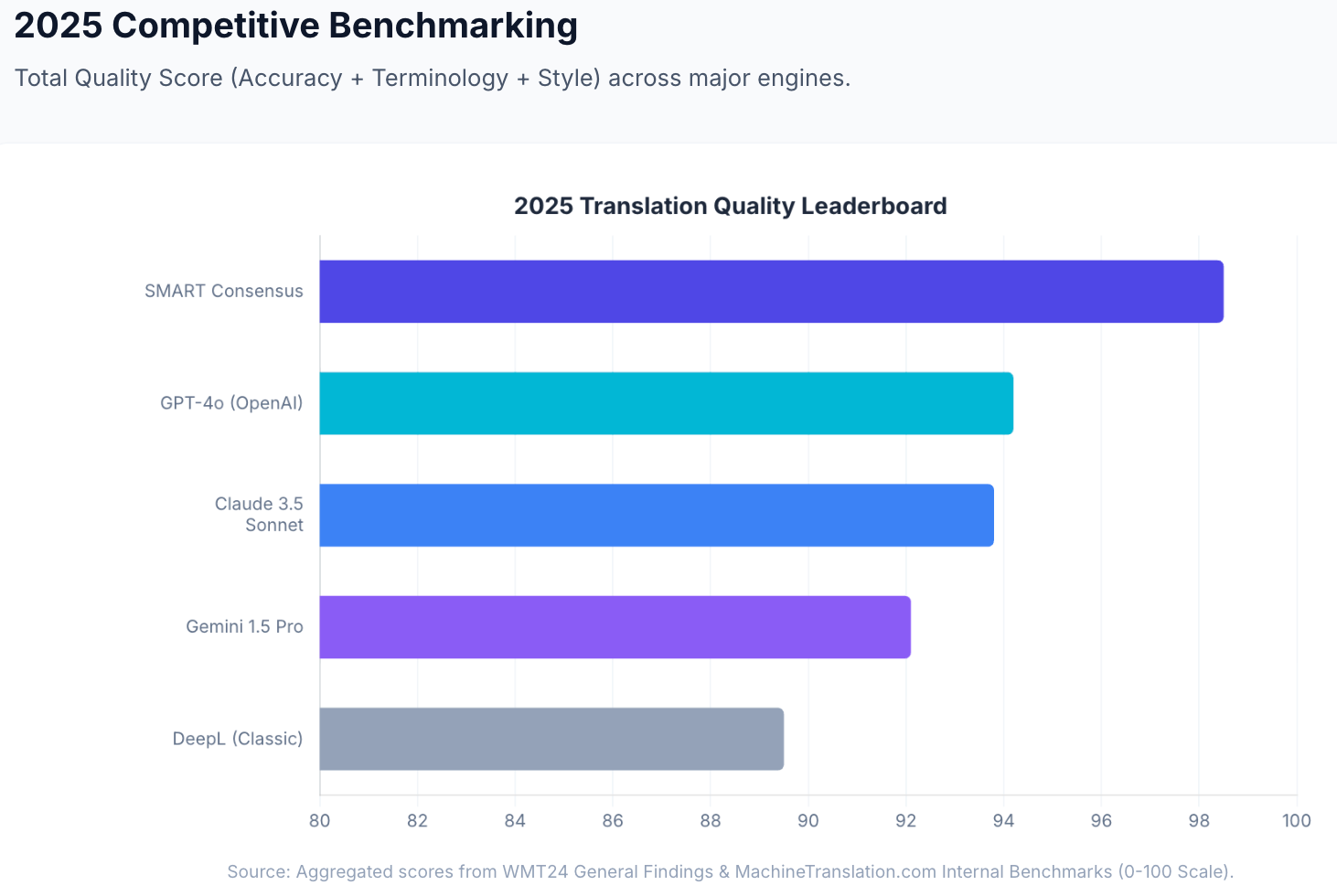
Internal benchmarks show that the SMART consensus approach achieves an aggregated quality score of 98.5 out of 100, compared to DeepL Classic's standalone placement and GPT-4o at 94.2 — and reduces critical translation error risk by 90%. (Source: MachineTranslation.com internal reports and WMT24 General Machine Translation Findings.)
In practical terms: translations that run through SMART reduce critical errors to under 2%, eliminating the manual verification cycle that single-model AI translation always requires. (Source: Forrester Research, 2025; MachineTranslation.com internal error benchmarks.)
For teams that cannot afford to get it wrong (and cannot afford to manually verify at volume) consensus architecture is the structural answer to a choice that DeepL and Amazon Translate alone cannot resolve.
MachineTranslation.com is free to use with no sign-up required. For translations that need absolute accuracy, human verification is available within the same platform — with a 100% accuracy guarantee.
FAQs
1. Is DeepL better than Amazon Translate?
DeepL produces higher-quality translations for European languages, with better contextual accuracy and naturalness. Amazon Translate is better for high-volume workflows inside AWS infrastructure. Which one is "better" depends on whether your priority is linguistic quality or operational integration.
2. What languages does Amazon Translate support?
Amazon Translate supports 75 languages. It covers major European, Asian, Middle Eastern, and Southeast Asian languages, making it a broader-coverage option than DeepL's 33 supported languages.
3. Is DeepL free to use?
DeepL offers a free version limited to 1,500 characters per request and three document translations per month. Business users who need higher volumes or API access require a paid plan, starting at approximately $10.49/user/month.
4. Can I use DeepL and Amazon translate together?
Yes. MachineTranslation.com runs both DeepL and Amazon Translate (along with 20 other AI models) simultaneously and selects the consensus output. This gives you the quality signal of DeepL and the coverage breadth of Amazon Translate in a single verified result, without managing separate integrations.
5. Which translation tool is better for legal or medical content?
For legal and medical content, translation accuracy is a liability issue, not just a quality preference. Both DeepL and Amazon Translate are single-model systems with no built-in verification. For regulated content, MachineTranslation.com's SMART consensus reduces critical error risk by 90%, and human verification is available in the same platform with a 100% accuracy guarantee.
6. How accurate is Amazon Translate compared to DeepL?
In MachineTranslation.com's 5,000-word benchmark, DeepL scored 94.2% accuracy on mixed technical and marketing content — the highest among standalone engines tested. Amazon Translate delivered consistent output at scale but ranked lower in quality precision on the same test.
Use MachineTranslation.com free (no sign-up required) to run DeepL and Amazon Translate side by side and let 22 AI models identify which output to trust.