April 24, 2026
Benefits of globalization: Why translation quality determines whether they materialise
The economic and cultural case for globalization is well-established. Businesses that access international markets grow faster, reach larger customer bases, and tap into talent and innovation that domestic markets cannot provide. These benefits are real and well-documented.
What is less often examined is the degree to which they depend on language. Not just on having translation in place, but on translation quality specifically. Companies that translated content to communicate with and retain customers were 2.67 times more likely to experience increased revenue, and 2.6 times more likely to improve profits, according to the Unbabel Global Multilingual CX Report. But 57% of online shoppers abandon purchases when they cannot understand a website's language (CSA Research). The gap between those two statistics is translation quality: the difference between localization that converts and localization that misleads or confuses.
This article covers the main benefits of globalization for businesses, the challenges it introduces, and the practical role language quality plays in determining which side of those statistics your business lands on.
In this article
- Access to new markets
- Economic growth and revenue diversification
- Access to global talent
- Cultural exchange and innovation
- The challenges globalization introduces
- How language quality affects each benefit
- Frequently asked questions
Access to new markets
For most businesses, the primary driver of international expansion is revenue. A domestic market has a ceiling. International markets multiply the addressable audience and reduce the risk of overdependence on a single economy. This is the foundational benefit of globalization, and it is straightforward in principle.
In practice, reaching a new market requires more than a logistical presence. Customers in that market need to be able to understand your product, trust your brand, and navigate your purchasing experience in their own language. The 57% purchase abandonment figure from CSA Research represents not a hypothetical risk but a measured behaviour: when language fails, buyers leave.
The businesses that consistently realise this benefit are the ones that treat multilingual communication as a quality problem, not just a coverage problem. Translation exists on most international e-commerce sites. What separates the ones that convert from the ones that don't is whether that translation is accurate enough to build confidence rather than erode it.
Economic growth and revenue diversification
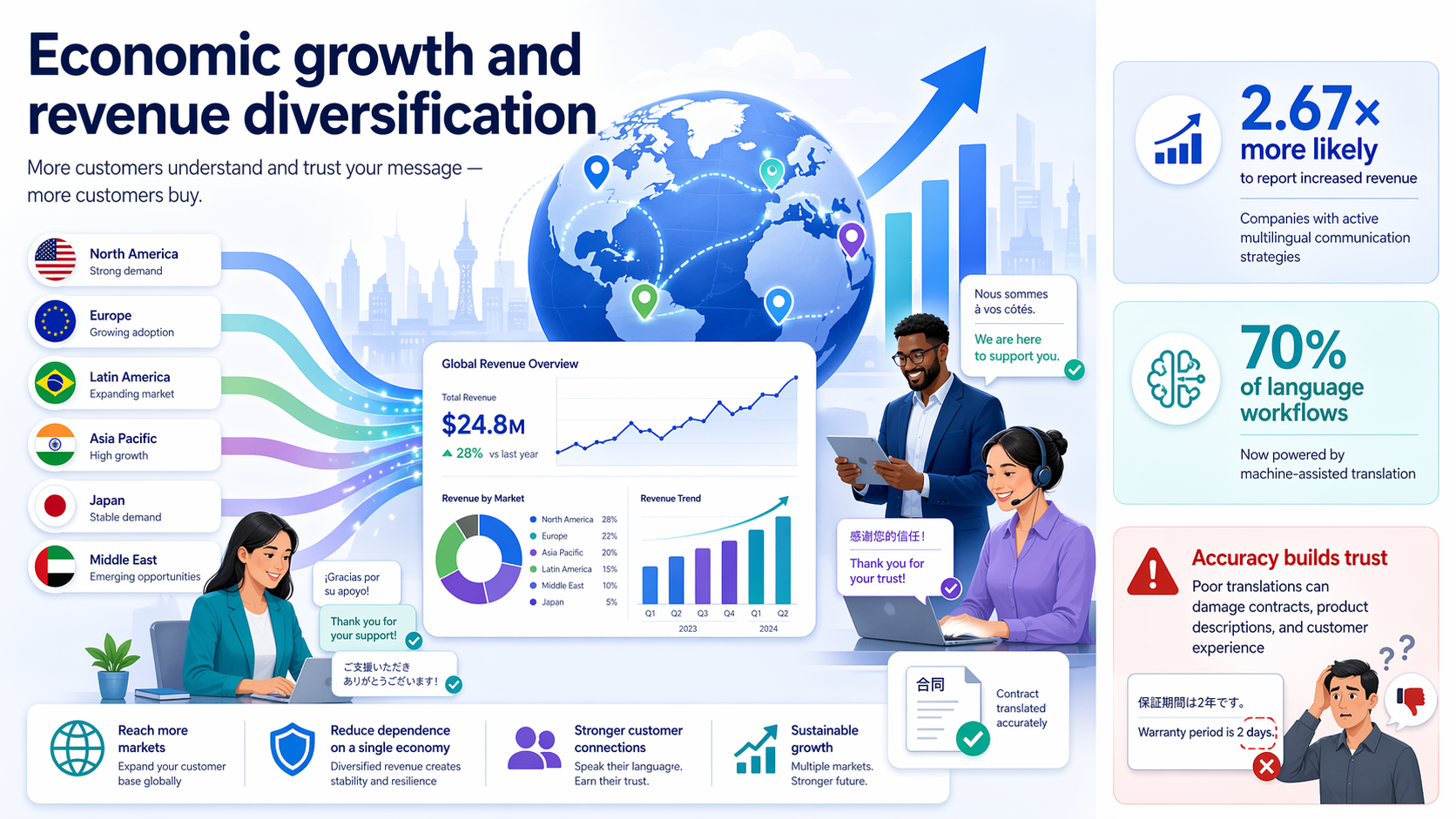
Expanding internationally reduces dependence on a single economy and its cycles. A business generating revenue across multiple markets is less exposed to a domestic recession, a local competitive disruption, or a shift in consumer behaviour in one region.
The data on this is reasonably consistent. Companies with active multilingual communication strategies are 2.67 times more likely to report increased revenue than those without, according to the Unbabel Global Multilingual CX Report. The mechanism is not complicated: more customers who can understand and trust your communications means more customers who buy.
What this data also reveals is the baseline condition: the revenue uplift associated with multilingual communication assumes that communication is accurate. A mistranslated contract clause, a product description that reads as unprofessional, or a customer service interaction that loses nuance in translation can undo the trust that market entry is designed to build. Machine-assisted translation now powers 70% of language workflows according to the Lokalise Localization Trends Report (2025), but volume without accuracy creates a different problem: consistent exposure to error.
Access to global talent
Globalization extends beyond customer markets. It applies equally to the talent market. A business that can recruit, onboard, and communicate with employees across languages has access to a significantly deeper pool of skills, perspectives, and domain expertise than one constrained to a single language.
This matters particularly in fields where specific skills are scarce domestically. Engineering, research, creative, and clinical roles often have stronger candidate pools in other countries or regions than at home. The ability to run multilingual hiring processes, provide training materials in multiple languages, and conduct effective performance management across language barriers is a direct operational advantage.
Machine translation plays a practical role in each of these workflows. The quality requirement shifts depending on context: internal communications have more tolerance for imprecision than externally-facing documentation, but safety protocols, legal compliance materials, and terms of employment carry real liability if mistranslated.
Cultural exchange and innovation
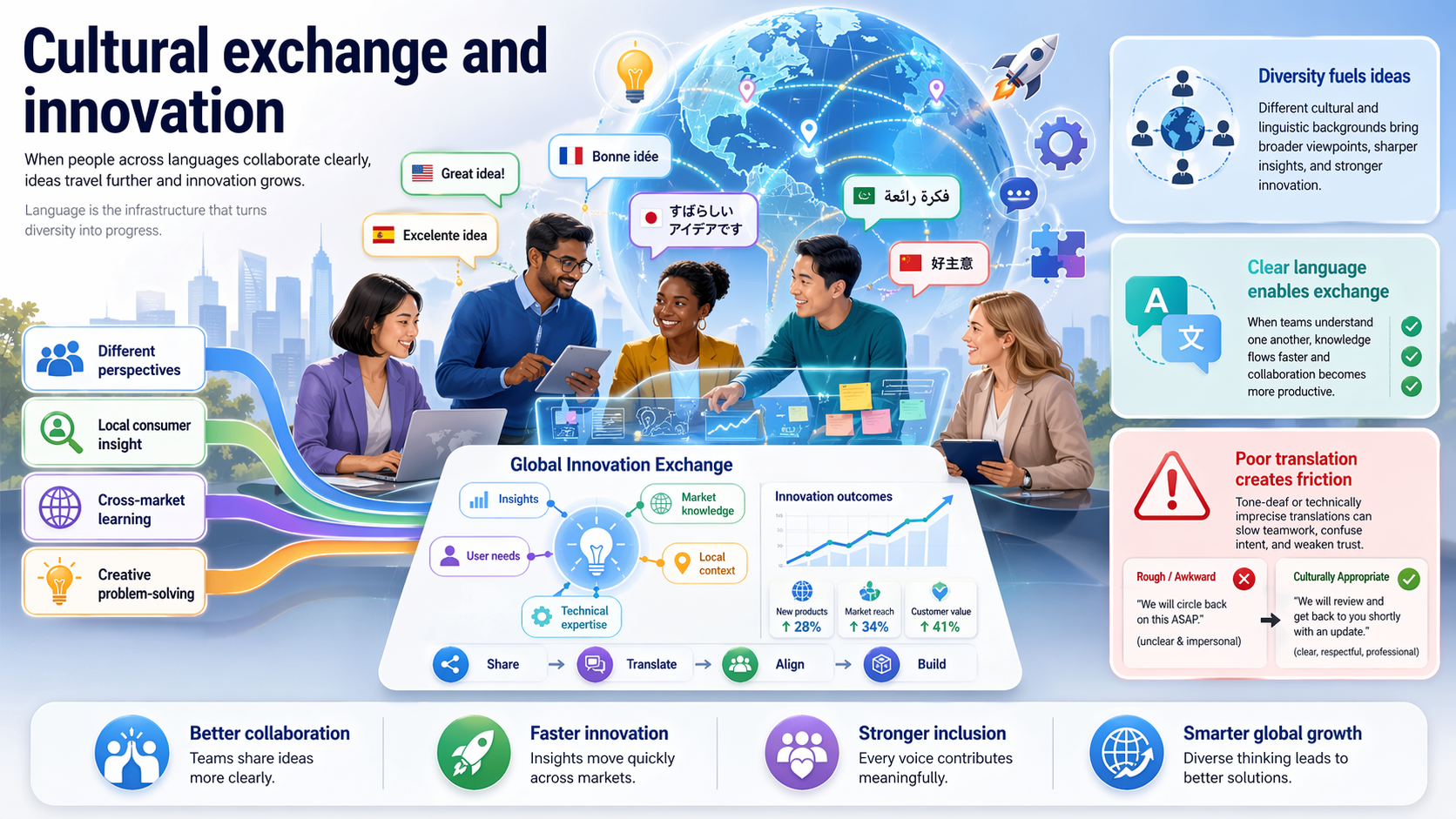
One of the less commercially-framed benefits of globalization is the cross-pollination of ideas that happens when people from different cultural and linguistic backgrounds work together. Diverse teams bring different problem-solving approaches, consumer insights, and domain knowledge. The business literature on team diversity and innovation performance is substantial, and the practical experience of many multinational companies confirms it.
Language is the infrastructure for that exchange. A team that cannot communicate effectively across languages does not fully capture the benefit of its diversity. Translation tools that produce culturally tone-deaf or technically imprecise output create friction in exactly the collaborative contexts where clarity matters most.
The challenges globalization introduces
The benefits above are real, but globalization also introduces pressures worth being clear-eyed about.
Regulatory complexity. Operating across jurisdictions means navigating different legal frameworks, compliance requirements, and reporting standards. Translation of legal documents is a category where errors carry direct liability: a clause mistranslated in a contract, a regulatory filing that shifts meaning, or a compliance notice that is not understood carry consequences that go beyond customer experience.
Cultural misalignment. Translation that is linguistically accurate but culturally inappropriate can damage brand perception in a target market. This is particularly relevant for marketing content, where tone, humour, and reference points are culturally specific and do not transfer literally.
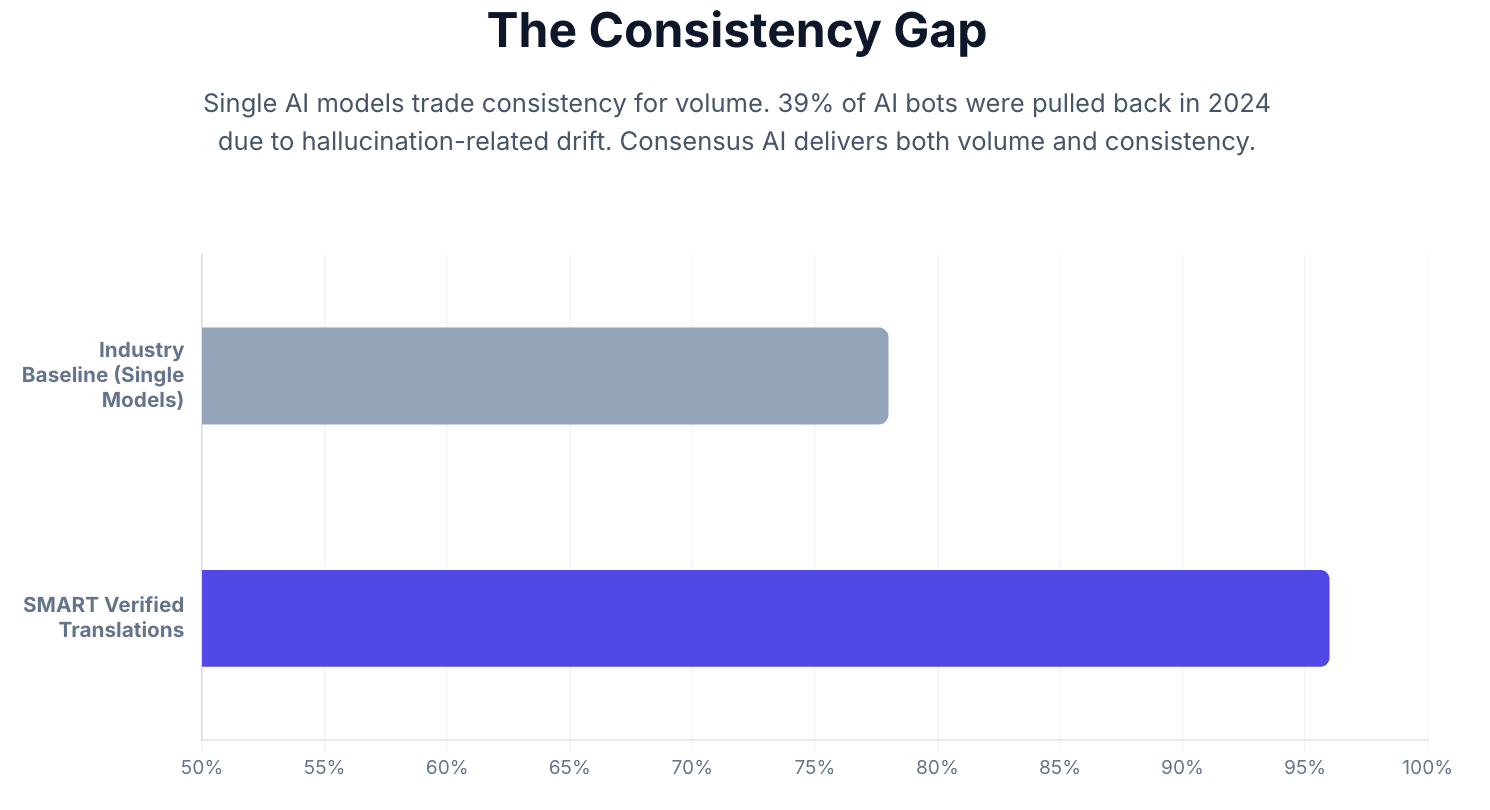
Communication consistency at scale. As an organisation grows internationally, the volume of multilingual communication grows with it. Maintaining consistent terminology, tone, and quality across that volume is a structural challenge. MachineTranslation.com's internal benchmarks show that single-model AI translation maintains consistent terminology and register at approximately 78% across multi-document workflows, compared to 96% for consensus-based outputs. For global brands where consistency is part of brand equity, that gap compounds at scale.
Supply chain and operational communication. Global supply chains involve communication across multiple tiers of suppliers, logistics providers, and regulatory bodies in different languages. Errors in operational translation, a specification misunderstood, a safety protocol not followed, produce problems that are harder to recover from than a lost sale.
How language quality affects each benefit
The pattern across each benefit above is consistent: the benefit depends on communication, and the value of that communication depends on its accuracy. This is not an argument for avoiding machine translation, machine-assisted translation now powers the majority of language workflows globally and makes multilingual communication possible at a scale that was not economically viable with human translation alone. It is an argument for being clear about what quality standard is required for each content type.
A rough framework:
For low-stakes internal content (internal memos, informal communications, early-stage research): general-purpose machine translation is adequate. Speed and cost matter more than precision.
For moderate-stakes customer-facing content (product descriptions, marketing copy, support documentation): accuracy and cultural appropriateness matter. A translation that sounds unnatural or contains errors damages the customer experience and erodes conversion rates.
For high-stakes professional or regulated content (legal documents, financial disclosures, medical information, contracts): translation errors carry liability. The cost of a mistranslation in these contexts is not a lost impression but a legal or clinical consequence.
The translation challenge for businesses scaling internationally is matching the right quality standard to each content type at volume. Single-model AI translation, whether an NMT engine or an LLM, produces a single output with no internal signal for when it has made an error. As MachineTranslation.com's internal analysis shows, the errors that remain in modern AI translation are almost entirely semantic: wrong register, wrong tone, wrong term. They do not announce themselves.
MachineTranslation.com addresses this at the architecture level. Its SMART mechanism runs every translation through 22 AI models simultaneously and selects the output the majority agrees on. Because errors are model-specific, cross-model agreement filters them out structurally. Internal data shows this approach cuts critical translation error risk by 90% compared to single-engine translation. For content where accuracy has consequences, that difference matters.
For businesses at the moderate to high-stakes end of the spectrum, human verification is also available within the same platform, providing a 100% accuracy guarantee from a qualified reviewer without an external agency or separate vendor.
MachineTranslation.com is free to use, no sign-up required, with a daily translation limit that resets automatically.
FAQs
1. What are the main benefits of globalization for businesses?
The core benefits are access to new markets and larger customer bases, revenue diversification across economies, access to a deeper global talent pool, and exposure to diverse perspectives that drive innovation. Each of these depends on effective multilingual communication to realise in practice.
2. What are the main challenges of globalization?
Regulatory complexity across jurisdictions, cultural misalignment in marketing and communication, maintaining consistent messaging quality at scale, and operational risks from translation errors in supply chain or compliance contexts are the most common challenges for businesses expanding internationally.
3. Why does translation quality matter for globalization?
CSA Research found that 57% of online shoppers abandon purchases when they cannot understand a website's language. Separate research from Unbabel found that companies actively communicating in customers' languages were 2.67 times more likely to see revenue growth. The gap between those outcomes runs through translation quality: localization that is present but inaccurate or tone-deaf produces the abandonment figure; localization that is accurate and culturally appropriate produces the revenue uplift.
4. What types of business content require the highest translation accuracy?
Legal, financial, medical, and regulatory documents carry direct liability if mistranslated. Contracts, compliance filings, clinical documentation, and terms of employment require the highest accuracy standard. For these content types, human verification by a qualified reviewer is the appropriate quality layer. Customer-facing marketing, product descriptions, and support materials require high-quality translation to protect brand perception and conversion rates.
5. What is the connection between globalization and machine translation?
Machine translation makes multilingual communication economically viable at scale. Traditional human translation was too slow and expensive for most business communication volumes. AI-powered machine translation handles the volume, but the quality standard required still varies by content type and has a direct impact on whether globalization's business benefits materialise. For professional-grade output, consensus-based systems that cross-check outputs across multiple models reduce the error risk that single-engine tools carry.
6. How do businesses translate content effectively for multiple markets?
The practical approach is to match the translation method to the content type and stakes involved. For high-volume, lower-stakes content, AI translation provides adequate quality at scale. For customer-facing or professionally sensitive content, a consensus-based approach (running content through multiple AI models and selecting the agreed output) significantly reduces error risk. For legally or clinically binding content, human verification by a qualified professional provides the accuracy guarantee that AI alone cannot yet reliably deliver.
Translate with 22 AI models at MachineTranslation.com. Free, no sign-up required.